Today's
EarthStation1.com 15% Off Commemorative Memorial Title: The Night
America Trembled The War Of The Worlds Broadcast DVD MP4 USB
Today, April 9, 2026
April 9: National Chicken Little
Awareness Day: -- An annual celebration of a folk tale about an
insanely scared chick who constantly thinks the world is coming to
an end. He is convinced of this because objects such as acorns
keep falling on his head, which he makes out to be the sky
falling. He goes on a quest around the farm warning the other
animals of this impending danger. They believe him and everybody
goes into a panic. They all join him in going to warn the king
about the disaster. After this point, there are different endings
to the tale. The most familiar one says that a fox invites the
farm animals to its lair and eats them all. In another version,
the rooster survives and warns the chick who then escapes. Other
versions say all the animals are rescued and make it to the king.
The story of Chicken Little goes back about 2,500 years and is a
traditional oral folk story. The exact record of where the story
was first told is a bit unclear. However, one of the first people
to record the tale was a Danish scholar named Just Mathias Thiele.
He was an employee of the Royal Danish Library. In Britain, this
story is commonly known as Chicken Licken or Henny Penny, but in
the United States, Chicken Little is the most common name. It
began appearing in books in the U.K. in the early 19th century
following the precedent set by the Grimm Brothers in publishing
folk tales. In the Scots and English versions, the animals are
determined to tell the king that the sky is falling, in contrast
to the American and Danish ones where they are not given any
specific motivation. However, in all versions, the fox eats them,
although in different circumstances. Today, the story has birthed
several different products. One example is movie worksheets to
help children with music lessons. The worksheets have questions
relating to the music in the Disney movie "Chicken Little."
The questions cover mood, instrumentation, voicing, instruments,
meter, dynamics, style, texture, instrument families, texture, and
genre. They're a fun and unique way for children to learn music.
Another type of worksheet helps kids develop critical thinking
skills. It challenges students to examine the concepts, events,
and characters in the Disney movie and then apply the lessons to
their lives. Who said children's stories were only for
entertainment? On Sale @ 15% Off Discount Till Midnight PT!
https://store.earthstation1.com/the-night-america-trembled-the-war-of-the-worlds-broadcast-dvd-mp4-us4.html
Today's
EarthStation1.com 15% Off Commemorative Memorial Title: POW:
Americans In Enemy Hands Documentary DVD, Download, USB Drive
Today, April 9, 2026
April 9: National Former Prisoner Of War
Recognition Day: -- A yearly recognition that honors the
courageous prisoners of war (POW or PW) and those who are still
missing in action (MIA). Did you know that prisoners of war must
be treated decently with respect? Yes, although they are prisoners
of war, they will be allowed to have all the basic rights. On this
day, back in 1942, American veterans were held by the Japanese and
endured harsh treatment. While some survived, there were countless
numbers of people that died on their way to the prison camps. War
is a brutal act that humans have carried out ever since they
learned to use sticks and stones as weapons. Prisoners of War
(POW), the people who are captured by the opposition party as
prisoners during the war, often endure atrocious treatment.
National Former Prisoner of War Recognition Day aims to honor
those courageous fighters of the nation who had to endure.
National Former Prisoners of War Recognition Day occurs on the
anniversary of the Bataan Death march. On April 9, 1942, the
United States Forces surrendered to the Imperial Japanese Army on
the Bataan Peninsula. All Survivors were loaded to a box train and
brought to Camp O'Donnell. During this march, POWs were physically
abused and tortured, causing the death of over 500 Americans. This
is called the Bataan Death March. Later, this action of the
Japanese Army was judged to be a Japanese War Crime. In 1984,
former POWs led a movement to recognize April 9, the day of the
Bataan Death March, as the National Former Prisoner of War
Recognition Day. On April 1, 1988, President Ronald Reagan
proclaimed April 9 be set aside to recognize the brave veterans.
Reagan announced the holiday through the Presidential Proclamation
5788, and congress agreed with the legislation. Since then, on
this day, every year, government officials, veterans, civic and
private organizations across the nation observe this day with
ceremonies and events. They also fly the POW/MIA flag on National
Former Prisoner of War Recognition Day. On Sale @ 15% Off Discount
Till Midnight PT!
https://store.earthstation1.com/pow-americans-in-enemy-hands--wwii-korea-vietnam-dvd.html
Today's
EarthStation1.com 15% Off Commemorative Memorial Title: Robert E.
Lee Documentaries DVD, MP4 Video Dowload, USB Flash Drive
Today, April 9, 2026
April 9: Appomattox Day: -- April 9,
1865: The American Civil War (The Civil War, The War Between The
States): The Eastern Theater Of The American Civil War: The
Appomattox Campaign: The Battle Of Appomattox Court House: (The
Surrender Of Robert E. Lee, The Surrender Of The Army Of Northern
Virginia, The Commencement Of The Conclusion Of The American Civil
War, The First Surrender Agreement Of The Confederate States Of
America (CSA) (The First Surrender Agreement Of The Confederate
State (C.S.), The First Surrender Agreement Of The Confederacy,
The First Surrender Agreement Of The South): -- The practical and
effective end of the American Civil War occurs with the Union
victory at The Battle of Appomattox Court House, fought that
morning in Appomattox County, Virginia, one of the last battles of
the American Civil War and the final engagement of Confederate
General in Chief Robert E. Lee and his Army Of Northern Virginia,
a battle that led to their surrender to the Union Army Of The
Potomac under the Commanding General Of The United States Army,
Ulysses S. Grant, in the village of Appomattox Court House, The
signing of the surrender documents occurred that afternoon in the
parlor of the house owned by Wilmer McLean; his house near
Manassas, Virginia, was involved in the First Battle Of Bull Run
in 1861, and he thereafter moved to Appomattox, Virginia, to
escape the war, thinking that there it would be safe; instead, it
was there that the Civil War ended, and his houses were,
therefore, involved in one of the first and one of the last
encounters of the American Civil War. Generous terms of surrender,
written by Gen. Grant, allowed Confederates to keep their horses,
officers were allowed to keep their swords and side arms, and were
allowed to return home after a war that cost 500,000 American
lives. Appomattox Day is an annual commemoration of that event.
Lee, having abandoned the Confederate capital of Richmond,
Virginia, after the nine-and-a-half-month Siege of Petersburg and
Richmond, retreated west, hoping to join his army with Confederate
forces, the Army of Tennessee in North Carolina. Union infantry
and cavalry forces under General Philip Sheridan pursued and cut
off the Confederates' retreat at the central Virginia village of
Appomattox Court House. Lee launched a last-ditch attack to break
through the Union forces to his front, assuming the Union force
consisted entirely of lightly armed cavalry. When he realized that
the cavalry was now backed up by two corps of federal infantry, he
had no choice but to surrender with his further avenue of retreat
and escape now cut off. On April 12, a formal ceremony of parade
and the stacking of arms led by Confederate Maj. Gen. John B.
Gordon to Union Brig. Gen. Joshua Chamberlain marked the
disbandment of the Army of Northern Virginia with the parole of
its nearly 28,000 remaining officers and men, free to return home
without their major weapons but enabling men to take their horses
and officers to retain their sidearms (swords and pistols), and
effectively ending the war in Virginia. This event triggered a
series of subsequent surrenders across the South, in North
Carolina, Alabama and finally Shreveport, Louisiana, for the
Trans-Mississippi Theater in the West by June, signaling the end
of the four-year-long war. On Sale @ 15% Off Discount Till
Midnight PT!
https://store.earthstation1.com/robert-e-lee-documentaries-dvd.html
Today's
EarthStation1.com 15% Off Commemorative Memorial Title: Heroes
Still... The Bataan Death March DVD, MP4 Download, USB Drive
Today, April 9, 2026
April 9: Day Of Valor (Filipino: Araw Ng
Kagitingan): Bataan Day (Fall Of Bataan Day, Bataan Death March
Commemoration Day): -- April 9, 1942: World War II: The Pacific
War (The Asia-Pacific War, The Pacific Theater Of World War II):
The Pacific Ocean Theater Of World War II: The Philippines
Campaign (1941-1942) (The Battle Of The Philippines, The Fall Of
The Philippines): The Battle Of Bataan (The Fall Of Bataan): --
The Bataan peninsula, which along with the island of Corregidor
were the last remaining Allied strongholds in the Philippines,
falls to the Imperial Japanese Army's final assault, which had
begun on April 3, on the combined Filipino and American forces
making their determined last stand there. The Fall Of Bataan was
also the beginning of The Bataan Death March, when American and
Filipino prisoners were forced on a six day march, beginning at
Mariveles Airfield to Camp O'Donnell in Cabanatuan with various
susidiary marches joining it from San Fernando, Bagac and the
Capas Train Station. 76,000 Allied POWs including 12,000 Americans
were forced to walk 60 miles under a blazing sun without food or
water to the POW camp, resulting in over 5,000 American deaths. A
national holiday in the Philippines, The Day Of Valor (Araw Ng
Kagitingan), previously called Bataan Day, commemorates The Fall
Of Bataan, and came to also commemorate The Fall Of Corregidor.
The Dambana Ng Kagitingan (Shrine Of Valor, Shrine Of Courage;
official name Mount Samat National Shrine) is a historical shrine
located near the summit of Mount Samat in the town of Pilar,
Province of Bataan, in the Philippines. The memorial shrine
complex was built to honor and remember the gallantry of Filipino
and American soldiers who fought against the Imperial Japanese
Army during World War II. The memorial grounds feature a colonnade
that houses an altar, an esplanade, and a museum, and on the peak
of the mountain is a memorial cross standing about 311 feet (95 m)
high. The Battle Of Bataan (January 7 - April 19, 942) represented
the most intense phase of Imperial Japan's invasion of the
Philippines during World War II. In January 1942, forces of the
Imperial Japanese Army and Navy invaded Luzon along with several
islands in the Philippine Archipelago after the bombing of the
American naval base at Pearl Harbor. The commander-in-chief of all
Filipino and U.S. forces in the islands, General Douglas
MacArthur, consolidated all of his Luzon-based units on the Bataan
Peninsula to fight against the Japanese invaders. By this time,
the Japanese controlled nearly all of Southeast Asia. Despite a
lack of supplies, Filipino and American forces managed to fight
the Japanese for three months, engaging them initially in a
fighting retreat southward. The delay caused by their valiant and
determined resistance -- bringing about a comradery between the
men of arms of both countries that was to remain a steadfast
bastion of Filipino-American relations for decades to come - cost
the Japanese valuable time and prevented their immediate victory
across the Pacific. The surrender at Bataan, with 76,000 soldiers
surrendering in the Philippines altogether, was the largest in
American and Filipino military histories, and was the largest
United States surrender since the American Civil War's Battle of
Harper's Ferry. On Sale @ 15% Off Discount Till Midnight PT!
https://store.earthstation1.com/heroes-still-the-bataan-death-march-dvd-mp4-us4.html
Today's
EarthStation1.com 15% Off Commemorative Memorial Title: The Green
Berets & Special Forces Documentary Set 2 MP4s Or 2 DVDs
Today, April 9, 2026
April 9: Special Forces Branch Official
Birthday: -- April 9, 1987: #BOTD: #HBD! Special Forces Branch
Official Birthday: The United States Army Special Forces (SF),
colloquially known as the "Green Berets" due to their
distinctive service headgear, also known simply as Special Forces,
is #born. Originally formed on Jun 19, 1952 as The 10th Special
Forces Group (Airborne) under Col. Aaron Bank soon after the
establishment of the Psychological Warfare School (which
eventually became John F. Kennedy Special Warfare Center And
School), it was split, with the cadre that kept the designation
10th SFG deployed to Bad Tolz, Germany, in September 1953, and the
remaining cadre at Fort Bragg formed into the 77th Special Forces
Group, which in May 1960 was reorganized and designated as today's
7th Special Forces Group. Since their original formation in 1952,
Special Forces soldiers have operated in Vietnam, Cambodia, Laos,
North Vietnam, Guatemala, Nicaragua, El Salvador, Colombia,
Panama, Haiti, Somalia, Bosnia, Kosovo, 1st Gulf War, Afghanistan,
Iraq, the Philippines, Syria, Yemen, Niger and, in an FID role,
East Africa. Hover, it was not until April 9, 1987 that these
Special Forces were established as a basic branch of the United
States Army by Department Of The Army General Order No. 35. The US
Army Special Forces are a special operations force of the United
States Army geared towards nine doctrinal missions: unconventional
warfare, foreign internal defense, direct action,
counterterrorism, counterinsurgency, special reconnaissance,
information operations, counterproliferation of weapons of mass
destruction, and security force assistance. The unit emphasizes
language, cultural, and training skills in working with foreign
troops; recruits are required to learn a foreign language as part
of their training and must maintain knowledge of the political,
economic, and cultural complexities of the regions in which they
are deployed. Other Special Forces missions, known as secondary
missions, include combat search and rescue (CSAR),
counter-narcotics, hostage rescue, humanitarian assistance,
humanitarian demining, peacekeeping, and manhunts. Other
components of the United States Special Operations Command
(USSOCOM) or other U.S. government activities may also specialize
in these secondary missions. The Special Forces conduct these
missions via seven geographically focused groups. Many of their
operational techniques are classified, but some nonfiction works
and doctrinal manuals are available. As special operations units,
Special Forces are not necessarily under the command authority of
the ground commanders in those countries. Instead, while in
theater, SF units may report directly to a geographic combatant
command, USSOCOM, or other command authorities. The Central
Intelligence Agency's (CIA) highly secretive Special Activities
Center, and more specifically its Special Operations Group (SOG),
recruits from U.S. Army Special Forces. Joint CIA-Army Special
Forces operations go back to the unit MACV-SOG during the Vietnam
War, and were seen as recently as the War in Afghanistan
(2001-2021). On Sale @ 15% Off Discount Till Midnight PT!
https://store.earthstation1.com/the-green-berets-amp-the-story-of-special-forces-dvd-mp4-us4.html
Today's
EarthStation1.com 15% Off Commemorative Memorial Title: Churchill
In His Own Voice LP Record Album Set MP3, DVD, Download, USB
Today, April 9, 2026
April 9: National Winston Churchill Day:
-- A national commemoration of the day President Kennedy, on April
9, 1963, signed into law a bill making Winston Churchill an
honorary citizen of the United States. It wasn't his birthday, or
even the day of his death (he was still very much alive), but the
day did have military significance for us all. Sir Winston,
knighted by the Queen for his wartime service to England, is
credited with unifying the British people during the darkest days
of World War II, and it can be convincingly argued that he saved
Western Civilization. There's much to be said about the
half-American, half-English, all-grit treasure that is Winston
Churchill. Born to a wealthy American mother descended from an
Algonquin Indian princess and a leading British politician Duke Of
Marlborough father, Winston Churchill was born into greatness. His
early years, however, proved to be difficult, struggling with
academia and his studies. His teacher's called him "unpunctual
and careless." However, as he grew older, Churchill excelled
in history and began writing poetry that was published in school
magazines. After repeated insisting by his father, Churchill began
preparation for a military career and graduated from the Royal
Military Academy in 1894. In his early 20s from 1895 to 1900,
Churchill saw combat in Cuba, India, Sudan, and South Africa, was
mentioned in dispatches and recommended for a decoration, earned
four campaign medals and the Spanish Order of Military Merit,
wrote five books, established himself as a popular war
correspondent and lecturer, gained international fame as an
escaped prisoner of war, and was elected to a seat in Parliament,
all before his twenty-sixth birthday. He would later lead Britain
into victory during the second World War under his command as
prime minister. As a celebrated politician, army officer, and
writer, it's hard to even determine which he had been the most
impactful to. With a Nobel Prize in Literature, numerous medals of
honor and an undeniable impact on the world we live in today, we
choose this day to honor a man who didn't just achieve greatness,
he personified it. On Sale @ 15% Off Discount Till Midnight PT!
https://store.earthstation1.com/churchill-in-his-own-voice-double-record-album-mp3-c3.html
Today's
EarthStation1.com 15% Off Commemorative Memorial Title: The Great
War (1964) TV Documentary Series DVD, Video Download, USB
Today, April 9, 2026
April 9: Vimy Ridge Day (Canada): --
April 9, 1917: The European Civil War: World War I: The First
European War (The European Theater Of World War I): The Western
Front Of World War I: The Battle Of Arras (The Second Battle Of
Arras): The Battle Of Vimy Ridge: -- The four divisions of the
Canadian Corps in the British First Army execute a massive assault
on Vimy Ridge against three divisions of the German 6th Army in
the Nord-Pas-de-Calais region of France, marking the beginning of
The Battle Of Vimy Ridge, which took place from April 9 to 12,
1917. Vimy Ridge Day is an annual commemoration of that event. The
Battle Of Vimy Ridge was part of the opening phase of The Battle
Of Arras, a British offensive from April 9 to May 16, 1917 where
British troops attacked German defences near the French city of
Arras on the Western Front, attacks that paved the way for The
Nivelle Offensive (April 16 - May 9, 1917), a Franco-British
offensive on the Western Front in the First World War, intended to
attract German reserves from the French front. The objective of
the Canadian Corps at Vimy Ridge was to take control of the
German-held high ground along an escarpment at the northernmost
end of the Arras Offensive. This would ensure that the southern
flank could advance without suffering German enfilade fire.
Supported by a creeping barrage, the Canadian Corps captured most
of the ridge during the first day of the attack. The village of
Thelus fell during the second day of the attack, as did the crest
of the ridge, once the Canadian Corps overcame a salient against
considerable German resistance. The final objective, a fortified
knoll located outside the village of Givenchy-en-Gohelle, fell to
the Canadian Corps on 12 April. The German forces then retreated
to the Oppy-Mericourt line. Historians attribute the success of
the Canadian Corps in capturing the ridge to a mixture of
technical and tactical innovation, meticulous planning, powerful
artillery support and extensive training, as well as the failure
of the German 6th Army properly to apply the new German defensive
doctrine. The battle was the first occasion when all four
divisions of the Canadian Expeditionary Force participated in a
battle together and it was made a symbol of Canadian national
achievement and sacrifice. A 100-hectare (250-acre) portion of the
former battleground serves as a memorial park and site of the
Canadian National Vimy Memorial. On Sale @ 15% Off Discount Till
Midnight PT!
https://store.earthstation1.com/the-great-war-dvd-set-1964-wwi-tv-series-26-shows-1964266.html
Today's
EarthStation1.com 15% Off Commemorative Memorial Title: Pirates 12
Part Documentary Series MP4 Video Download DVD
Today, April 9, 2026
April 9: Jenkins' Ear Day: -- April 9,
1731: Crime: Organized Crime: Piracy: The Golden Age Of Piracy
(1650s-1730s): The French-Habsburg Rivalry: The Austro-Prussian
Rivalry: The War Of The Austrian Succession: The War Of Jenkins'
Ear: -- Spanish coast guards led by privateer Juan de Leon Fandino
invade, search, and raid the British smuggling brig Rebecca,
commanded by British privateer Captain Robert Jenkins. The
incident became a contributory cause of the War of Jenkins' Ear
(October 22, 1739 - October 18, 1748) between the Kingdom of Great
Britain and the Kingdom of Spain. Returning home from a trading
voyage in the West Indies in command of the smuggling brig Rebecca
in April 1731, Jenkins' ship was stopped and boarded by the
Spanish guarda-costa or privateer La Isabela on suspicion of
smuggling. According to some accounts, her commander, Juan de Leon
Fandino, had Jenkins bound to a mast, then sliced off his left ear
with his sword and allegedly told him to say to his King "the
same will happen to him (the king) if caught doing the same".
On arriving in Britain on June 11, Jenkins addressed his
grievances to the king, and gave a deposition which was passed to
the Duke of Newcastle in his capacity as Secretary of State for
the Southern Department (as such responsible for the American
colonies). In his deposition of June 18, 1731, which was reported
in the Pennsylvania Gazette for October 7 1731, Jenkins stated
that the Spanish captain (in Pennsylvania Gazette, it referred to
Spanish lieutenant Dorce instead) "took hold of his left Ear
and with his Cutlass slit it down, and then another of the
Spaniards took hold of it and tore it off, but gave him the Piece
of his Ear again." This report was then forwarded to the
Commander-in-chief in the West Indies, who then complained of
Jenkins' treatment to the Governor of Havana. The exact reason why
the Spanish privateers chopped off his ear is unclear. Some
accounts say it was a punishment for raiding Spanish ships, while
others say Rebecca was carrying contraband. There is no evidence
corroborating the oft-repeated story that in spring 1738 Jenkins
told his story with dramatic details before a committee of the
House of Commons, producing his severed ear (pickled in a jar).
According to this story, Jenkins returned to England with his
pickled ear in a bottle, which had a tremendous effect on the
nation. So much so that The House of Commons summoned him in March
1738 to appear before them and produce the severed ear. Jenkins
dutifully did so to the astonishment of the House. Those in
attendance asked him what he had done to warrant such treatment.
To this, Jenkins replied, "I commended my soul to God and my
cause to my country." This story stirred up the country's
imagination. The power of this shriveled object was immense and
the ear became a symbol of English pride. To this extent, the ear
started a war between England and Spain in 1739. Consequently, the
war is known as the War of Jenkins' Ear which occurred in several
waves. There were several diplomatic negotiation attempts between
England and Spain throughout the 1730s in Europe and America.
However, these only heightened the animosity between the two
nations, leading to the War of Jenkins' Ear in late 1739. The
Royal Naval commander in Port Royal said that people involved in
what he described as "clandestine trade" had no right to
complain if their cargoes were confiscated and often indulged in
violence. After all, such incidents were seen as normal at the
time - the cost of doing business. The English people were enraged
by the incident and demanded that the Spanish be taught a lesson.
Cutting off Englishmen's ears was unacceptable! The British
launched attacks on Spanish possessions in Central America,
resulting in high casualties mainly from disease. After 1742, this
war was overtaken by the wider War of the Austrian Succession, in
which most of the powers of Europe took part. Peace was only
restored with the Treaty of Aix-la-Chapelle in 1748.
Traditionally, the main cause of the War of Jenkins' Ear has been
stated as a dispute between Spain and Britain over access to
markets in Spanish America. However, in recent times, historians
such as Woodfine and Anderson argue that this was only one of many
issues. The other reasons include tensions with Spain over
colonial expansion in North America and French concern at the
growth in British commercial strength from 1714. On Sale @ 15% Off
Discount Till Midnight PT!
https://store.earthstation1.com/pirates-12-part-documentary-series-mp4-video-download-124.html
Today's
EarthStation1.com 15% Off Commemorative Memorial Title: The Second
Russian Revolution TV Series DVD, Video Download, USB Drive
Today, April 9, 2026
April 9: Day Of National Unity (Georgia):
-- April 9, 1989: The Aftermath Of World War II: The Cold War: The
Dissolution Of The Soviet Union: The Revolutions Of 1989 (The Fall
Of Nations, The Autumn Of Nations, The Fall Of Communism): The
April 9 Tragedy (The Massacre Of Tbilisi, The Tbilisi Tragedy): --
A peaceful anti-Soviet demonstration and hunger strike in Tbilisi,
Georgia which demanded restoration of Georgian independence is
brutally crushed by the Soviet Army, resulting in 21 deaths and
hundreds of injuries. The Day Of National Unity is an annual
public holiday in commemoration of the event, and on the second
anniversary of the tragedy, the Supreme Council of the Republic of
Georgia proclaimed Georgian sovereignty and independence from the
Soviet Union, so that both Georgia's Day Of National Unity
coincides with Georgia's Independence Day holiday. When local
Soviet authorities had lost control over the protests, First
Secretary of the Georgian Communist Party Jumber Patiashvili asked
the USSR leadership to send troops to restore order and impose a
curfew. In the evening of April 8, 1989, Colonel General Igor
Rodionov, Commander of the Transcaucasus Military District,
ordered his troops to mobilize. Moments before the attack by the
Soviet forces, the Patriarch of Georgia Ilia II addressed the
demonstrators asking them to leave Rustaveli Avenue and the
vicinity of the government building due to the danger which
accumulated during the day after appearance of Soviet tanks near
the avenue. The demonstrators refused to disband even after the
Patriarch's plea. The local Georgian militsiya (police) units were
disarmed just before the operation. On April 9, at 3:45 a.m.,
Soviet APCs and troops under General Igor Rodionov surrounded the
demonstration area. Later, Rodionov claimed in his interview that
groups of Georgian militants attacked unarmed soldiers with
stones, metal chains and rods. The Soviet troops received an order
from General Rodionov to disband and clear the avenue of
demonstrators by any means necessary. The Soviet detachment, armed
with military batons and spades (a favorite weapon of Soviet
special forces, advanced on demonstrators moving along Rustaveli
Avenue. During the advance, the soldiers started to attack
demonstrators with spades, inflicting injuries both minor and
serious to anyone who was struck. One of the victims of the attack
was a 16-year-old girl who tried to get away from the advancing
soldiers, but was chased down and beaten to death near the steps
of the government building, receiving blows to the head and chest.
She was dragged out of the area by her mother, who was also
attacked and wounded. This particularly violent attack was
recorded on video from the balcony of a building located on the
other side of the avenue. The video was used in the aftermath as
evidence during Soviet politician Anatoly Sobchak's Parliamentary
commission on investigation of events of April 9, 1989. Groups of
Soviet soldiers were reported to chase individual victims, rather
than dispersing the crowd. CN and CS gas were used against the
demonstrators; vomiting, respiratory problems and sudden paralyses
of the nervous system were reported. The unarmed police officers
attempted to evacuate the panicked group of demonstrators, however
a video taken secretly by opposition journalists showed that
soldiers did not allow doctors and emergency workers to help the
injured people; even ambulances were attacked by the advancing
soldiers Captured on film, the image of a young man beating a tank
with a stick became a symbol of the Georgian anti-Soviet movement.
The stampede as people fled from the attack resulted in the death
of 19 people, among them 17 women. Autopsies conducted on the
victims concluded the direct cause of death of all those who died,
with the exception of one case of serious skull and brain injury,
was suffocation (asphyxia) caused by both the compression of the
body and the inhalation of chemical substances. On April 11, The
Georgian TV showed the bodies of the 17 women violently killed,
demonstrating alleged brutality by the Soviet soldiers, as the
faces of the deceased women were hard to identify due to the
facial injuries and blows to the head. The Soviet government
blamed the demonstrators for the death of the 20 people, claiming
that they had trampled each other while panicking and retreating
from the advancing Soviet soldiers. Ironically there was some
truth in this, as Soviet troops had blocked all exits from the
area except for one narrow passage, which made flight from the
area difficult and induced a crowd crush and, possibly, some
desperate defensive violence by the trapped demonstrators.
Official Soviet reports blamed the demonstrators for causing the
clash, saying that the troops were attacked with sticks and
knives. According to Tass, the soldiers followed orders not to use
their weapons, but that extremists attacked them with pieces of
metal, bricks and sticks. Tass described the demonstrators as
stirring interethnic strife and calling for the overthrow of the
Georgian government. General Secretary of the Soviet Communist
Party Mikhail Gorbachev slammed "actions by irresponsible
persons" for loss of life. He said that the disturbances
sought to overthrow the Georgian government and stir ethnic
tension in Georgia. A foreign ministry spokesman said that the
clashes were sparked by "die-hard nationalists, extremists
and political adventurists who are abusing democratization to the
detriment of our new policy of openness and of our very society."
A parliamentary commission on investigation of the events of April
9, 1989, in Tbilisi was launched by Anatoly Sobchak, a member of
the Congress of People's Deputies of Soviet Union. After full
investigation and inquiries, the commission confirmed the
government's claim that the deaths had resulted from trampling,
but another contributing factor had been the chemical substances
used against the demonstrators. It condemned the military, which
had caused the deaths by trying to disperse demonstrators. The
commission's report made it more difficult to use military power
against demonstrations of civil unrest in the Soviet Union.
Sobchak's report presented a detailed account of the violence
which was used against the demonstrators and recommended the full
prosecution of military personnel responsible for the April 9
event. On April 10, the Soviet government issued a statement
blaming the demonstrators for causing unrest and danger to the
safety of the public. On April 10, in protest against the
crackdown, Tbilisi and the rest of Georgia went out on strike and
a 40-day period of mourning was declared. People brought massive
collections of flowers to the place of the killings. A state of
emergency was declared, but demonstrations continued. The
government of the Georgian SSR resigned as a result of the event.
Moscow claimed the demonstrators attacked first and the soldiers
had to repel them. At the first Congress of People's Deputies
(May-June 1989) Mikhail Gorbachev disclaimed all responsibility,
shifting blame onto the army. The revelations in the liberal
Soviet media, as well as the findings of the "pro-Perestroika"
Deputy Anatoly Sobchak's commission of enquiry into the Tbilisi
events, reported at the second Congress in December 1989, resulted
in embarrassment for the Soviet hardliners and army leadership
implicated in the event. The April 9 tragedy radicalised Georgian
opposition to Soviet power. A few months later, a session of the
Supreme Council of Georgian SSR, held on November 17-18, 1989,
officially condemned the occupation and annexation of Democratic
Republic of Georgia by Soviet Russia in 1921. The events of April
9 also gave rise to the so-called 'Tbilisi Syndrome'. This
syndrome was characterized by the reluctance of military officers
and soldiers to take any tactical decisions or even obey orders
without a clear trail of responsibility to a higher authority. It
arose because of the Soviet leadership's refusal to take
responsibility for the orders to clear the square and the
commission report's and Shevardnadze's criticism of the military
in general. 'Tbilisi Syndrome' continued to spread in the coming
years, especially following events in Baku and Vilnius, and
contributed in 1991 to the refusal of soldiers to prevent
demonstrations during the August 1991 putsch. On March 31, 1991,
Georgians voted overwhelmingly in favor of independence from the
Soviet Union in a referendum. With a 90.5% turnout, approximately
99% voted in favor of independence. On April 9, the second
anniversary of the tragedy, the Supreme Council of the Republic of
Georgia proclaimed Georgian sovereignty and independence from the
Soviet Union. A memorial to the victims of the tragedy was opened
at the location of the crackdown on Rustaveli Avenue on November
23, 2004. On Sale @ 15% Off Discount Till Midnight PT!
https://store.earthstation1.com/the-second-russian-revolution-6-dvd-set-complete-tv-serie6.html
Today's
EarthStation1.com 15% Off Commemorative Memorial Title:
Shevardnadze Uncovered Eduard Shevardnadze's Georgia DVD MP4 USB
Drive
Today, April 9, 2026
April 9: Independence Day (Georgia)
(Unofficial): -- An annual commemoration of the independence of
Georgia from the Soviet Union. Georgia's independence was restored
when the April 9, 1991 Act Of The Restoration Of State
Independence Of Georgia was adopted by the Supreme Council Of The
Republic Of Georgia. The national symbols used by the DRG were
re-established as those of the newly independent nation and
remained in use until 2004. May 26, marking the May 26, 1918
establishment of the Democratic Republic Of Georgia (DRG), is
still celebrated as a national holiday - the Independence Day of
Georgia - but due to its symbolism and historical significance,
April 9 has been advocated to be recognized as Independence Day by
the groups associated with the 1980s national movement and the
government of Zviad Gamsakhurdia, which presided over the
Declaration Of Independence on April 9, 1991. On Sale @ 15% Off
Discount Till Midnight PT!
https://store.earthstation1.com/shevardnadze-uncovered-eduard-shevardnadze39s-georgia-dvd-mp4-394.html
Today's
EarthStation1.com 15% Off Commemorative Memorial Title: The Mongol
Hordes: Storm From The East TV Series DVD MP4 USB Drive
Today, April 9, 2026
April 9, 1288: The Mongols: Mongol
Invasions And Conquests: The Mongol Invasions Of Vietnam: The
Third Mongol Invasion Of Vietnam: The Battle Of Bach Dang (1288):
-- One of the greatest victories in both Vietnamese and world
military history occurs in a naval battle considered to be a
tactical masterpiece when Mongol leader Kublai Khan's invading
Yuan forces, commanded by Admirals Omar Bin Nars Al-Din Khan and
Fan Yi , are defeated by Vietnamese Tran forces, commanded by
Commander-in-Chief Prince Tran Quoc Tuan (Prince Hung Dao) in a
battle on the Bach Dang River near Ha Long Bay in present-day
Quang Ninh province along the northeastern coast of Vietnam. The
Battle Of Bach Dang was the last major engagement during Mongol
campaigns between the kingdom of Dai Viet (modern-day northern
Vietnam) tuled by the Tran adynasty and the smaller kingdom of
Champa (modern-day central Vietnam) and the Yuan dynasty. Prince
Hung Dao perfectly staged an ambush that destroyed the Yuan fleet
and captured its general, ending Kublai's intention to conquer Dai
Viet and Champa. The battle was a tactical masterpiece of the same
stature as a previous Battle Of Bach Dang that occurred in 938. In
the early morning of April 9, the naval fleet led by Omar, and
escorted by infantry, fled home along the Bach Dang river. The
Yuan Army was too large and unsustainable to continue operations
in Vietnam, so on March 30, its commander Prince Toghon, ninth son
of the Yuan dynasty Kublai Khan, decided to withdraw his army back
to China. The withdrawing Chinese then entered Prince Hung Dao's
trap on April 9 during high tide. A small fleet of Vietnamese
junks sailed unopposed and attacked the Yuan fleet, then
retreated. Then the tide receded, with the Yuan fleet pursuing and
battling the Vietnamese junks, revealing wooden stakes that had
been planted into the river bed. With the Yuan fleet stuck in the
trap, the Vietnamese junks returned and destroyed the immobilized
Yuan warships. Thousands of Yuan troops jumped into the river and
were killed or drowned.[11] Fan Yi, seeing Omar's fleet being
destroyed, and his commanding fleet surrounded by Vietnamese small
junks, tried to escape. Fan Yi jumped into the river, but was
killed by the Vietnamese. The battle lasted from sunrise to
sundown. and the Vietnamese captured 400 Yuan warships after
totally destroying the rest of the Yuan fleet. On Sale @ 15% Off
Discount Till Midnight PT!
https://store.earthstation1.com/the-mongol-hordes-storm-from-the-east-tv-series-dvd-mp4-usb-driv4.html
Today's
EarthStation1.com 15% Off Commemorative Memorial Title: The
Western Tradition TV Series DVD, MP4 Video Download, USB Drive
Today, April 9, 2026
April 9, 1413: The English Monarchy (The
Monarchy Of The Kingdom Of England): Coronations: The Coronation
Of Henry V: -- Henry V is crowned King of England at Westminster
Abbey; the ceremony was marked by a terrible snowstorm, but the
common people were undecided as to whether it was a good or bad
omen. Henry was described as having been "very tall (6 feet 3
inches), slim, with dark hair cropped in a ring above the ears,
and clean-shaven". His complexion was ruddy, the face lean
with a prominent and pointed nose. Depending on his mood, his eyes
flashed from mild kindness to brilliant ferocity. Henry V, also
called Henry Of Monmouth (September 16, 1386 - August 31, 1422)
was King of England from 1413 until his death in 1422. Despite his
relatively short reign, Henry's outstanding military successes in
the Hundred Years' War against France made England one of the
strongest military powers in Europe. Immortalised in Shakespeare's
"Henriad" plays, Henry is known and celebrated as one of
the greatest warrior-kings of medieval England. During the reign
of his father Henry IV, Henry gained military experience fighting
the Welsh during the revolt of Owain Glyndwr and against the
powerful aristocratic Percy family of Northumberland at the Battle
of Shrewsbury. Henry acquired an increased role in England's
government due to the king's declining health, but disagreements
between father and son led to political conflict between the two.
After his father's death in 1413, Henry assumed control of the
country and asserted the pending English claim to the French
throne. In 1415, Henry embarked on war with France. His first
military campaign included his famous victory at the Battle of
Agincourt in 1415. By 1420, his armies had captured Paris and had
come close to conquering the whole of medieval France. Taking
advantage of political divisions within France, he conquered large
portions of Northern France, resulting in Normandy's occupation by
the English for the first time since the mid-14th century. After
months of negotiation with Charles VI of France, the 1420 Treaty
of Troyes recognised Henry V as regent and heir apparent to the
French throne, and he was subsequently married to Charles's
daughter, Catherine of Valois. Everything seemed to point to the
formation of a union between the kingdoms, in the person of Henry.
However, he died two years later and was succeeded by his only
child, the infant Henry VI. Analyses of Henry's reign are varied.
He was widely praised for his personal piety, bravery and military
genius even by contemporary French chroniclers, but his
occasionally cruel temperament and lack of focus on domestic
affairs has made him the subject of some criticism. Nonetheless,
his militaristic pursuits during the Hundred Years' War created a
strong sense of English nationalism and set the stage for the rise
of England and then later Britain to prominence as a dominant
global power. On Sale @ 15% Off Discount Till Midnight PT!
https://store.earthstation1.com/the-western-tradition-dvd-set-all-52-shows-13-d5213.html
Today's
EarthStation1.com 15% Off Commemorative Memorial Title: The
American Adventure: TV History Series 1607-1876 DVD MP4 USB Drive
Today, April 9, 2026
April 9, 1585: The Colonial History Of
The United States: The British Colonization Of The Americas: The
Roanoke Colony (The Lost Colony): -- An expedition organised by
Sir Walter Raleigh departs Plymouth, Devon, England for Roanoke
Island (now in North Carolina) in an attempt to found The Roanoke
Colony, the first permanent English settlement in America. The
expedition consisted of a fleet of seven ships: The galleass Tiger
(fleet commander Sir Richard Grenville's flagship, with with Simon
Fernandes as pilot), the flyboat Roebuck (captained by John
Clarke), Red Lion (under the command of George Raymond), Elizabeth
(captained by Thomas Cavendish), Dorothy (Raleigh's personal ship,
perhaps captained by Arthur Barlowe) and two small pinnaces (light
boats, propelled by oars or sails, carried aboard merchant and war
vessels in the Age of Sail to serve as a tender. The establishment
of the Roanoke Colony was an attempt by Sir Walter Raleigh to
found the first permanent English settlement in North America. The
English, led by Sir Humphrey Gilbert, had briefly claimed St.
John's, Newfoundland, in 1583 as the first English territory in
North America at the royal prerogative of Queen Elizabeth I, but
Gilbert was lost at sea on his return journey to England. Roanoke
colony was founded by governor Ralph Lane in 1585 on Roanoke
Island in what is now Dare County, North Carolina, United States.
Lane's colony was troubled by a lack of supplies and poor
relations with the local Native Americans. While awaiting a
delayed resupply mission by Sir Richard Grenville, Lane abandoned
the colony and returned to England with Sir Francis Drake in 1586.
Grenville arrived two weeks later and also returned home, leaving
behind a small detachment to protect Raleigh's claim. Following
the failure of the 1585 settlement, a second expedition, led by
John White, landed on the same island in 1587, and set up another
settlement. Sir Walter Raleigh had sent him to establish the
"Cittie of Raleigh" in Chesapeake Bay. That attempt
became known as the Lost Colony due to the subsequent unexplained
disappearance of its population. During a stop to check on
Grenville's men, flagship pilot Simon Fernandes forced White and
his colonists to remain on Roanoke. White returned to England with
Fernandes, intending to bring more supplies back for his colony in
1588. The Anglo-Spanish War delayed White's return to Roanoke
until 1590, and upon his arrival he found the settlement fortified
but abandoned. The cryptic word "CROATOAN" was found
carved into the palisade, which White interpreted to mean the
colonists had relocated to Croatoan Island. Before White could
follow this lead, rough seas and a lost anchor forced the mission
to return to England. The fate of the approximately 112-121
colonists remains unknown. Speculation that they had assimilated
with nearby Native American communities appears in writings as
early as 1605. Investigations by the Jamestown colonists produced
reports that the Roanoke settlers had been massacred and stories
of people with European features in Native American villages, but
no hard evidence was produced. Interest in the matter fell into
decline until 1834, when George Bancroft published his account of
the events in A History of the United States. Bancroft's
description of the colonists, particularly White's infant
granddaughter Virginia Dare, cast them as foundational figures in
American culture, and captured the public imagination. Despite
this renewed interest, modern research has failed to find
archaeological evidence to explain the disappearance of the
colonists. On Sale @ 15% Off Discount Till Midnight PT!
https://store.earthstation1.com/the-american-adventure-series-us-1st-century-4-dv14.html
Today's
EarthStation1.com 15% Off Commemorative Memorial Title:
Montparnasse Revisited: The Genius That Was Paris DVD, MP4, USB
Drive
Today, April 9, 2026
April 9, 1821: #BOTD: #HBD: Charles
Baudelaire, controversial French Romantic, decadent and modernist
poet, essayist, art critic and translator, known for his mastery
of rhyme and rhythm, containing an exoticism inherited from
Romantics which, mixed with his observations of real life, mark
him as the first Modernist; he coined the term modernity (French:
modernite) to designate the fleeting, ephemeral experience of life
in an urban metropolis, and the responsibility art has to capture
that experience (d. August 31, 1867) is #born Charles Pierre
Baudelaire in Paris, France to father Joseph-Francois Baudelaire
(1759-1827), a senior civil servant and amateur artist, who at age
60 was 34 years older than his second wife, Baudelaire's
26-year-old mother, Caroline (nee Dufays) (1794-1871). Charles
Baudelaire was baptized two months after his birth at
Saint-Sulpice Roman Catholic Church. His most famous work, a book
of lyric poetry titled Les Fleurs du mal (The Flowers of Evil),
expresses the changing nature of beauty in modern, industrializing
Paris during the 19th century. He was especially critical of Seine
Prefect Georges-Eugene Haussmann's urban renewal project known as
Haussmann's Renovation Of Paris, a vast public works programme
commissioned by Emperor Napoleon III between 1853 and 1870, which
included the demolition of medieval neighbourhoods that were
deemed overcrowded and unhealthy by officials at the time; the
building of wide avenues; new parks and squares; the annexation of
the suburbs surrounding Paris; and the construction of new sewers,
fountains and aqueducts. Haussmann's work was met with fierce
opposition, and he was finally dismissed by Napoleon III in 1870;
but work on his projects continued until 1927. The street plan and
distinctive appearance of the centre of Paris today are largely
the result of Haussmann's renovation. Baudelaire was also a
pioneering translator of Edgar Allan Poe. and noted for his
critiques of Poe, Eugene Delacroix, Richard Wagner, Theophile
Gautier, Edouard Manet and Nadar. Many of Baudelaire's
philosophical proclamations were considered scandalous and
intentionally provocative in his time. He wrote on a wide range of
subjects, drawing criticism and outrage from many quarters. Along
with Poe, Baudelaire named the arch-reactionary Joseph de Maistre,
a Savoyard philosopher, writer, lawyer, and diplomat who advocated
social hierarchy and monarchy in the period immediately following
the French Revolution, as his Maitre A Penser (French: Mentor,
Guru), and adopted increasingly aristocratic views. In his
journals, he wrote "There is no form of rational and assured
government save an aristocracy. [_] There are but three beings
worthy of respect: the priest, the warrior and the poet. To know,
to kill and to create. The rest of mankind may be taxed and
drudged, they are born for the stable, that is to say, to practise
what they call professions." Charles Baudelaire died in a
Paris, France sanitorium from the effects of a massive stroke and
aphasia (inability to comprehend or formulate language due to
brain damage) at the age of 46. He is buried in the Cimetiere du
Montparnasse, Paris. On Sale @ 15% Off Discount Till Midnight PT!
https://store.earthstation1.com/montparnasse-revisted-the-genius-that-was-paris-3-dvd3.html
Today's
EarthStation1.com 15% Off Commemorative Memorial Title: World War
1 TV Series With Robert Ryan DVD, Video Download, USB Drive
Today, April 9, 2026
April 9, 1865: #BOTD: Erich Ludendorff,
German general and politician (d. December 20, 1937) is #born
Erich Friedrich Wilhelm Ludendorff in Ludendorff near Posen,
Province of Posen, Kingdom of Prussia (now Kruszewnia, Poznan
County, Poland). Erich Ludendorff was the victor of the Battle Of
Liege and the Battle Of Tannenberg during the early days of the
First World War. From August 1916, his appointment as
Quartermaster general (German: Erster Generalquartiermeister) made
him the leader (along with Paul von Hindenburg) of the German war
efforts during World War I. The failure of Germany' great Spring
Offensive in 1918 in quest of total victory was his great
strategic failure and he was forced out in October 1918. After the
war, Ludendorff became a prominent nationalist leader, and a
promoter of the Stab-in-the-back myth, which posited that the
German loss in World War I was caused by the betrayal of the
German Army by Marxists, Bolsheviks, and Jews who were furthermore
responsible for the disadvantageous settlement negotiated for
Germany in the Treaty Of Versailles. He took part in the failed
Kapp Putsch (coup) with Wolfgang Kapp in 1920 and the Beer Hall
Putsch of Adolf Hitler in 1923, and in 1925, he ran unsuccessfully
for the office of President of Germany against his former superior
Hindenburg. From 1924 to 1928, he represented the German Volkisch
Freedom Party in the Reichstag (legislature). Consistently
pursuing a purely military line of thought, Ludendorff developed
after the war, the theory of "Total War", which he
published as Der totale Krieg (The Total War) in 1935. In this
work, he argued that the entire physical and moral forces of the
nation should be mobilized, because peace was merely an interval
between wars. Ludendorff was a recipient of the Grand Cross of the
Iron Cross and the Pour le Merite, which was the highest military
order of merit in Germany. Erich Ludendorff died of liver cancer
in the private clinic Josephinum in Munich, Germany at the age of
72. He was given, against his explicit wishes, a state funeral
organized and attended by Hitler, who declined to speak at his
eulogy. He is buried in the Neuer Friedhof in Tutzing in Bavaria.
On Sale @ 15% Off Discount Till Midnight PT!
https://store.earthstation1.com/world-war-1-robert-ryan-4-dual-layer-dvds-26-episode-tv-se1426.html
Today's
EarthStation1.com 15% Off Commemorative Memorial Title: Sold Down
The River: Black Freedom Lost After Civil War DVD, MP4, USB
Today, April 9, 2026
April 9, 1866: The Reconstruction Era
(Reconstruction): The Civil Rights Act Of 1866: -- The first
United States federal law to define citizenship and affirm that
all citizens are equally protected by the law passes over
President Andrew Johnson's veto to allow it to become law without
presidential signature. The Civil Rights Act Of 1866 (14 Stat.
27-30, enacted April 9, 1866, reenacted 1870) conferred
citizenship on Blacks and gave them "the same right, in every
State and Territory... as is enjoyed by white citizens."It
was mainly intended, in the wake of the American Civil War, to
protect the civil rights of persons of African descent born in or
brought to the United States. Ohio's Republican representative
John Bingham and other congressmen argued that Congress did not
yet have sufficient constitutional power to enact this law. After
the fourteenth amendment became effective, the 1866 Act was
reenacted as an addendum to the Enforcement Act of 1870 in order
to dispel any possible doubt as to its constitutionality. On Sale
@ 15% Off Discount Till Midnight PT!
https://store.earthstation1.com/sold-down-the-river-black-liberty39s-loss-after-civil-war-dvd-mp4-394.html
Today's
EarthStation1.com 15% Off Commemorative Memorial Title: The Second
Red Scare 1947-1957 Documentaries MP4 Video Download DVD
Today, April 9, 2026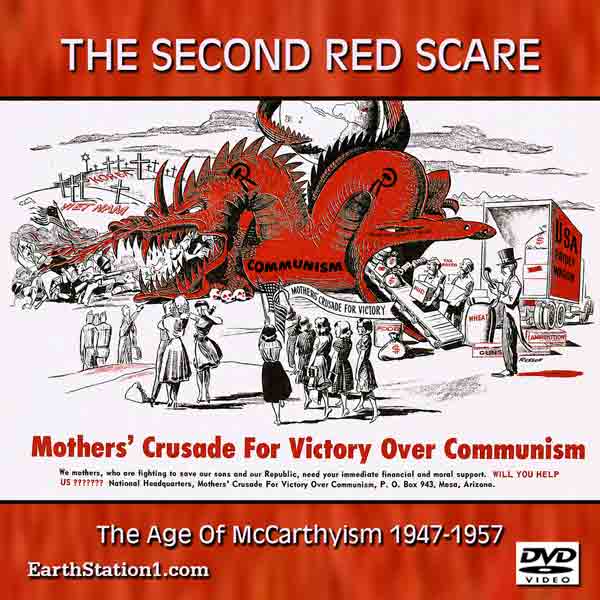
April 9, 1898: #BOTD: #HBD! Paul Robeson,
African American actor, singer, civil rights activist and Prince
Hall Freemason (d. January 23, 1976) is #born Paul Leroy Robeson
in Princeton, New Jersey. Paul Robeson was football player at
Rutgers College, and then had an international career in singing,
as well as acting in theater and movies. He became politically
involved in response to the Spanish Civil War, fascism, and social
injustices. His advocacy of anti-imperialism, affiliation with
communism, and criticism of the United States government caused
him to be blacklisted during the McCarthy era. Best known for his
performance in The Emperor Jones, he also enjoyed a long run on
Broadway in Shakespeare's Othello. In 1950, amid anti-Communist
hysteria, Robeson was denied a U.S. passport after refusing to
sign an affidavit on whether he had ever been a member of the
Communist Party. Paul Robeson, died following complications of a
stroke in Philadelphia at the age of 77. He lay in state in Harlem
and his funeral was held at his brother Ben's former parsonage,
Mother Zion AME Zion Church, where Bishop J. Clinton Hoggard
performed the eulogy. His 12 pall bearers included Harry Belafonte
and Fritz Pollard. He is interred in the Ferncliff Cemetery in
Hartsdale, New York. On Sale @ 15% Off Discount Till Midnight PT!
https://store.earthstation1.com/the-second-red-scare-19471957-documentaries-mp4-video-dow194719574.html
Today's
EarthStation1.com 15% Off Commemorative Memorial Title: The
Mexican Revolution 1910-1920 DVD, Video Download, USB Drive
Today, April 9, 2026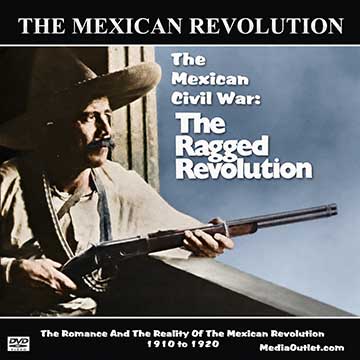
April 9, 1914: 20th Century Revolutions:
The Mexican Revolution: The Battle Of Veracruz: The United States
Occupation Of Veracruz: The Tampico Affair: -- A minor incident
involving United States Navy sailors and the Mexican Federal Army
loyal to Mexican dictator General Victoriano Huerta occurs which
became known as The Tampico Affair. Mexican forces provocatively
detain nine American sailors who had only come ashore to secure
supplies in the port of Tampico in Tampico, Tamaulipas, Mexico;
commanding USN Admiral Henry Mayo demanded that the US sailors be
released, and that Mexico issue an apology, raise and salute the
US flag, and perform a 21-gun salute. Mexico refused the demand,
but United States President Woodrow Wilson backed the demand,
ultimately resulting in The United States' Occupation Of Veracruz
(April 21 to November 23, 1914) and the concomitant beginning with
the Battle Of Veracruz, occurs. The incident came in the midst of
poor diplomatic relations between Mexico and the United States,
and was related to the ongoing Mexican Revolution. The occupation
further worsened relations, and led to widespread anti-Americanism
in Mexico. On the morning of April 21, 1914, warships of the
United States Atlantic Fleet under the command of Rear Admiral
Frank Friday Fletcher, began preparations for the seizure of the
Veracruz waterfront. Fletcher's orders were to "Seize custom
house. Do not permit war supplies to be delivered to Huerta
government or any other party." At 11:12 AM, consul William
Canada watched from the roof of the American Consulate as the
first boatload of Marines left the auxiliary vessel USS Prairie.
Whaleboats carrying 502 Marines from the 2nd Advanced Base
Regiment, 285 armed Navy sailors from the battleship USS Florida,
and a provisional battalion composed of the Marine detachments
from Florida and her sister ship USS Utah also began landing
operations. As planned earlier, American consul William W. Canada
notified General Gustavo Maass that Americans were occupying the
port and warned him to "cooperate with the naval forces in
maintaining order." Maass, however, was not permitted by
Mexico City to surrender the port. Maass ordered the Eighteenth
Regiment, under the command of General Luis B. Becerril, to
distribute rifles to the populace and to the prisoners in "La
Galera" military prison, and then all to proceed to the dock
area. Maass also ordered the Nineteenth Regiment, under the
command of General Francisco A. Figueroa, to take up positions on
Pier Number Four. Maass then radioed a dispatch to General Aurelio
Blanquet, Minister of War in Mexico City, of the American
invasion. Blanquet ordered Maass to not resist, but to retreat to
Tejeria, 10 kilometres (6 mi) inland. The landing party, under the
command of William R. Rush reached Pier 4 at 11:20. A large crowd
of Mexican and American citizens gathered to watch the spectacle.
The American invaders, under the command of Marine Lt. Col.
Wendell C. Neville, proceeded to their objectives without
resistance. By 11:45, the rail terminal and cable station were
occupied. Commodore Manuel Azueta encouraged cadets of the
Veracruz Naval Academy to take up the defense of the port for
themselves. U.S. Army Brigadier General Frederick Funston was
placed in control of the administration of the port. Assigned to
his staff as an intelligence officer was a young Captain Douglas
MacArthur. MacArthur joined the headquarters staff sent to the
area, arriving on May 1, 1914. He realized that the logistic
support of an advance from Veracruz would require the railroad.
Finding plenty of railroad cars in Veracruz but no locomotives,
MacArthur set out to verify a report that there were locomotives
in Alvarado. For 150USD in gold, he acquired a handcar and the
services of three Mexicans, whom he disarmed. MacArthur and his
party located five engines in Alvarado, two of which were only
switchers, but the other three were exactly what was required. On
the way back to Veracruz, his party was set upon by five armed
men. The party made a run for it and outdistanced all but two of
the armed men, whom MacArthur shot. Soon after, they were attacked
by about fifteen horsemen. MacArthur took three bullets in his
clothes but was unharmed. One of his companions was lightly
wounded before the horsemen retired, after MacArthur shot four of
them. Further on, the party was attacked a third time by three
horsemen. MacArthur received another bullet hole in his shirt, but
his men, using their handcar, managed to outrun all but one of
their attackers. MacArthur shot both that man and his horse; the
party had to remove the horse's carcass from the track before
proceeding. A fellow officer wrote to Wood recommending that
MacArthur be put forward for the Medal of Honor. Wood did so, and
Chief of Staff Hugh L. Scott convened a board to consider the
award. The board questioned "the advisability of this
enterprise having been undertaken without the knowledge of the
commanding general on the ground". This was Brigadier General
Frederick Funston, a Medal of Honor recipient himself, who
considered awarding the medal to MacArthur "entirely
appropriate and justifiable". However, the board feared that
"to bestow the award recommended might encourage any other
staff officer, under similar conditions, to ignore the local
commander, possibly interfering with the latter's plans";
consequently, MacArthur received no award. Huerta was not able to
respond to the US invasion due to his preoccupation with the
Mexican revolution. He had to contend with numerous revolts across
his country, the most notable of which were led in Chihuahua by
Villa and in the state of Morelos by Emiliano Zapata. Venustiano
Carranza, previously an ally of the federal government, also
revolted against Huerta in Coahuila, the state where he was
formerly governor. These rebellions eventually culminated in the
Battle of Zacatecas on the 24th of June, 1914, where the Federal
army lost 5,000 soldiers. The result was instrumental in bringing
about Huerta's resignation. The occupation still brought the two
countries to the brink of war and worsened U.S.-Mexican relations
for many years. Argentina, Brazil and Chile, who at the time were
negotiating the ABC pact, a proposed economic and political treaty
to prevent conflict in South America, held the Niagara Falls peace
conference in Niagara Falls, Ontario, Canada, on May 20 to avoid
an all-out war over this incident and to prevent American hegemony
over the region. A plan was formed in June for the US troops to
withdraw from Veracruz after General Huerta surrendered the reins
of his government to a new regime and Mexico assured the United
States that it would receive no indemnity for its losses in the
recent chaotic events. Huerta soon afterwards left office and gave
his government to Carranza. Carranza, who was still quite unhappy
with US troops occupying Veracruz, rejected the rest of the
agreement. In November 1914, after the Convention of
Aguascalientes ended and Carranza failed to resolve his
differences with revolutionary generals Pancho Villa and Emiliano
Zapata, Carranza left office for a short period and handed control
to Eulalio Gutierrez Ortiz. During this brief absence from power,
however, Carranza still controlled Veracruz and Tamaulipas. After
leaving Mexico City, Carranza fled to the state of Veracruz, made
the city of Cordoba the capital of his regime and agreed to accept
the rest of the terms of Niagara Falls peace plan. The US troops
officially departed on November 23. Despite their previous spat,
diplomatic ties between the US and the Carranza regime greatly
extended, following the departure of US troops from Veracruz.
After the fighting ended, U.S. Secretary of the Navy Josephus
Daniels ordered that fifty-six Medals of Honor be awarded to
participants in this action, the most for any single action before
or since. This amount was half as many as had been awarded for the
Spanish-American War, and close to half the number that would be
awarded during World War I and the Korean War. A critic claimed
that the excess medals were awarded by lot. Major Smedley Butler,
a recipient of one of the nine Medals of Honor awarded to Marines,
later tried to return it, being incensed at this "unutterable
foul perversion of Our Country's greatest gift" and claiming
he had done nothing heroic. The Department of the Navy told him to
not only keep it, but wear it. The controversy surrounding the
Veracruz Medals of Honor led to stricter standards for the
awarding of the Medal of Honor and the establishment of lower
ranking medals to recognize a wider range of accomplishments.
Mexico's Naval Lt. Azueta and a Naval Military School cadet, Cadet
Midshipman Virgilio Uribe, who died during the fighting, are now
part of the roll call of honor read by all branches of the Mexican
Armed Forces in all military occasions, alongside the six Ninos
Heroes of the Military College (nowadays the Heroic Military
Academy) who died in defense of the nation during the Battle of
Chapultepec on September 13, 1847. As a result of the brave
defense put up by the Naval School cadets and faculty, it has now
become the Heroic Naval Military School of Mexico in their honor
by virtue of a congressional resolution in 1949. As an immediate
reaction to the military invasion of Veracruz several anti-U.S
riots broke out in Mexico, Argentina, Chile, Costa Rica, Ecuador,
Guatemala, and Uruguay. U.S. citizens were expelled from Mexican
territory and some had to be accommodated in refugee campuses at
New Orleans, Texas City, and San Diego. Even the British
government was privately irritated, because they had previously
agreed with Woodrow Wilson that the United States would not invade
Mexico without prior warning. The military invasion of Veracruz
was also a decisive factor in favor of keeping Mexico neutral in
World War I. Mexico refused to participate with the United States
in its military excursion in Europe and guaranteed German
companies they could keep their operations open, especially in
Mexico City. Nevertheless, the tension between the US and Mexico
was great enough that the German government offered to help Mexico
reconquer territory lost to the US in the Mexican American war in
exchange for Mexican soldiers to help Germany in World War I. The
Mexican government refused this offer. U.S. President Woodrow
Wilson considered another military invasion of Veracruz and
Tampico in 1917-1918, so as to take control of Tehuantepec Isthmus
and Tampico oil fields, but this time the new Mexican President
Venustiano Carranza gave the order to destroy the oil fields in
case the Marines tried to land there. On Sale @ 15% Off Discount
Till Midnight PT!
https://store.earthstation1.com/the-ragged-revolution-mexican-revolt-191019101920.html
Today's
EarthStation1.com 15% Off Commemorative Memorial Title: The
Fabulous Sixties with Peter Jennings TV Docuseries MP4 Or DVD Set
Today, April 9, 2026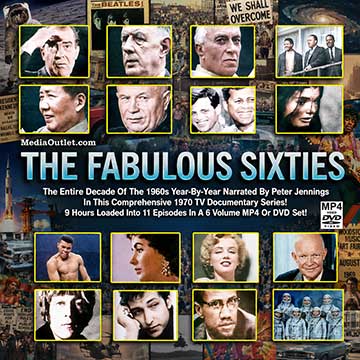
April 9, 1926: #BOTD: #HBD! Hugh Hefner,
American bon vivant, magazine publisher, founder of Playboy
Enterprises, founder and editor-in-chief of Playboy Magazine, and
a key figure in the Sexual Revolution (d. September 27, 2017) is
#born Hugh Marston Hefner in Chicago. Playboy Magazine, founded as
a publication with sexually revealing photographs and provocative
articles, provoked charges of obscenity. The first issue of
Playboy was published in 1953, featuring Marilyn Monroe in a nude
calendar shoot; it sold over 50,000 copies. Hefner extended the
Playboy brand into a world network of Playboy Clubs. He also
resided in luxury mansions where Playboy playmates shared his wild
partying life, fueling keen media interest. He was a political
activist in the Democratic Party and for the causes of First
Amendment rights, animal rescue, and the restoration of the
Hollywood Sign. Hefner died at the Playboy Mansion at the age of
91 of sepsis brought on by an E. coli infection. He is interred at
Westwood Memorial Park in Los Angeles, in the crypt beside Marilyn
Monroe, for which he paid 75K USD in 1992. "Spending eternity
next to Marilyn is an opportunity too sweet to pass up,"
Hefner had told the Los Angeles Times in 2009. On Sale @ 15% Off
Discount Till Midnight PT!
https://store.earthstation1.com/decades-the-1960s-dvd-set-peter-jennings-tv-series-3-19603.html
Today's
EarthStation1.com 15% Off Commemorative Memorial Title: The Movie
Life Of George: George Harrison's HandMade Films DVD MP4 USB
Today, April 9, 2026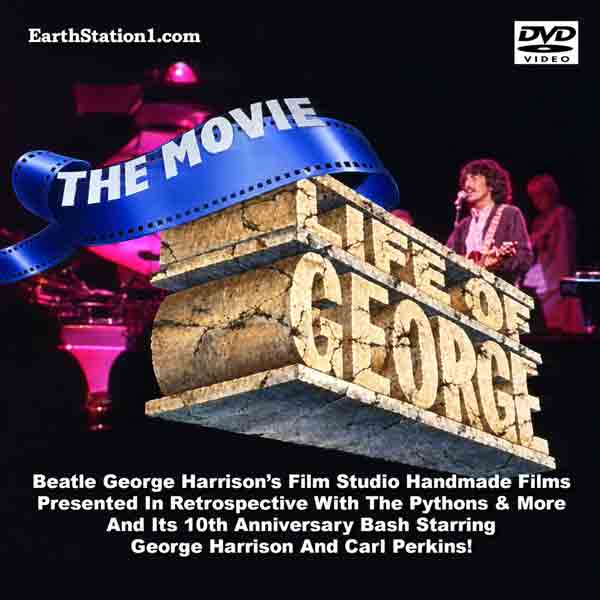
April 9, 1932: #BOTD: #HBD! Carl Perkins,
American rock and roll pioneer, rockabilly pioneer, singer,
songwriter and guitarist (d. January 19, 1998) is #born Carl Lee
Perkins in Tiptonville, Tennessee, the son of poor sharecroppers
Louise and Buck Perkins (misspelled on his birth certificate as
"Perkings"). Carl Perkins recorded most notably at the
Sun Studio, in Memphis, Tennessee, beginning in 1954. His
best-known song is "Blue Suede Shoes". Perkins' songs
were recorded by artists and friends as influential as Elvis
Presley, the Beatles, Jimi Hendrix, and Johnny Cash, which further
established his place in the history of popular music. Paul
McCartney claimed that "if there were no Carl Perkins, there
would be no Beatles.". Called "the King of Rockabilly",
he was inducted into the Rock and Roll Hall of Fame, the
Rockabilly Hall of Fame, the Memphis Music Hall of Fame, and the
Nashville Songwriters Hall of Fame. He also received a Grammy Hall
of Fame Award. Carl Perkins died at the age of 65 at
Jackson-Madison County Hospital in Jackson, Tennessee, from
complications from several minor strokes the previous month. Among
the mourners at his funeral at Lambuth University were George
Harrison, Jerry Lee Lewis, Wynonna Judd, Sam Phillips, Brian
Setzer, Garth Brooks, Nashville agent Jim Dallas Crouch, Dallas
rock and roll memorabilia executive Jacques Vroom, Jr., Johnny
Cash and June Carter Cash. Perkins is interred at Ridgecrest
Cemetery in Jackson. On Sale @ 15% Off Discount Till Midnight PT!
https://store.earthstation1.com/the-movie-life-of-george-handmade-films-dvd-mp4-us4.html
Today's
EarthStation1.com 15% Off Commemorative Memorial Title: Marian
Anderson Documentary DVD, MP4 Video Download, USB Flash Drive
Today, April 9, 2026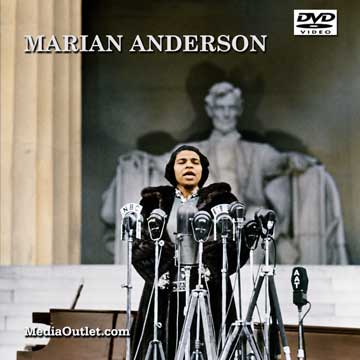
April 9, 1939: The American Civil Rights
Movement: Anti-Black Racism In The United States: Discrimination:
The 1939 Lincoln Memorial Concert: -- Marian Anderson sings at the
Lincoln Memorial, after being denied the right to sing at the
Daughters of the American Revolution's Constitution Hall. Marian
Anderson (1897-1993) was an African American contralto and one of
the most celebrated singers of the twentieth century. Music critic
Alan Blyth said: "Her voice was a rich, vibrant contralto of
intrinsic beauty." Most of her singing career was spent
performing in concert and recital in major music venues and with
famous orchestras throughout the United States and Europe between
1925 and 1965. Although offered roles with many important European
opera companies, Anderson declined, as she had no training in
acting. She preferred to perform in concert and recital only. She
did, however, perform opera arias within her concerts and
recitals. She made many recordings that reflected her broad
performance repertoire of everything from concert literature to
lieder to opera to traditional American songs and spirituals.
Between 1940 and 1965 the German-American pianist Franz Rupp was
her permanent accompanist. Anderson became an important figure in
the struggle for black artists to overcome racial prejudice in the
United States during the mid-twentieth century. In 1939, the
Daughters of the American Revolution (DAR) refused permission for
Anderson to sing to an integrated audience in Constitution Hall.
The incident placed Anderson into the spotlight of the
international community on a level unusual for a classical
musician. With the aid of First Lady Eleanor Roosevelt and her
husband Franklin D. Roosevelt, Anderson performed a critically
acclaimed open-air concert on Easter Sunday, April 9, 1939, on the
steps of the Lincoln Memorial in Washington, D.C. She sang before
a crowd of more than 75,000 people and a radio audience in the
millions. Anderson continued to break barriers for black artists
in the United States, becoming the first black person, American or
otherwise, to perform at the Metropolitan Opera in New York City
on January 7, 1955. Her performance as Ulrica in Giuseppe Verdi's
Un ballo in maschera at the Met was the only time she sang an
opera role on stage. Anderson worked for several years as a
delegate to the United Nations Human Rights Committee and as a
"goodwill ambassadress" for the United States Department
of State, giving concerts all over the world. She participated in
the civil rights movement in the 1960s, singing at the March on
Washington for Jobs and Freedom in 1963. The recipient of numerous
awards and honors, Anderson was awarded the Presidential Medal Of
Freedom in 1963, the Congressional Gold Medal in 1977, the Kennedy
Center Honors in 1978, the National Medal of Arts in 1986, and a
Grammy Lifetime Achievement Award in 1991. On Sale @ 15% Off
Discount Till Midnight PT!
https://store.earthstation1.com/marian-anderson-dvd-documentary.html
Today's
EarthStation1.com 15% Off Commemorative Memorial Title: The Radio
Broadcasts Of Lord Haw-Haw WWII MP3 CD, Download, USB Drive
Today, April 9, 2026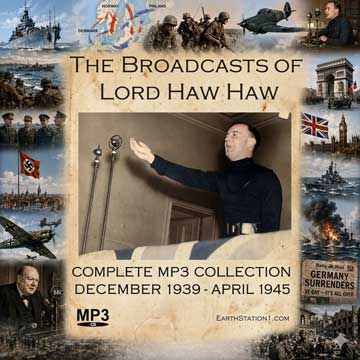
April 9, 1940: The European Civil War:
World War II: The Second European War (The European Theater Of
World War II): The German Invasion Of Denmark And Norway
(Operation Weserubung [German: Unternehmen Weserubung, "Operation
Weser Exercise]): -- At 5:15 in the morning, Germany invades
Denmark and Norway, ostensibly as a preventive manoeuvre against a
planned, and openly discussed, Franco-British occupation of
Norway. That same day, Vidkun Quisling, Norwegian army officer and
politician, seized power in Norway. The Germans had expected the
government to surrender and to have its replacement ready; neither
happened, although the invasion itself continued. After hours of
discussion, Quisling and his German counterparts decided that an
immediate coup was necessary, though this was not the preferred
option of the Germans. In the afternoon, Quisling was told by
German liaison Hans Wilhelm Scheidt that should he set up a
government - that is, should he initiate a coup - it would have
Hitler's personal approval. Quisling drew up a list of ministers
and, although it had merely relocated some 50 kilometres to
Elverum, accused the legitimate government of having "fled."
Meanwhile, the Germans occupied Oslo and at 17:30 Norwegian radio
ceased broadcasting at the request of the occupying forces. With
German support, at approximately 19:30, Quisling entered the NRK
studios in Oslo and proclaimed the formation of a new government
with himself as Prime Minister. He also revoked an earlier order
to mobilise against the German invasion. He still lacked
legitimacy. Two orders - the first, to a friend in the military
(Colonel Hans Sommerfeldt Hiorth, the commanding officer of the
army regiment at Elverum) to arrest the government, and the
second, to the Oslo chief of police - were both ignored. At 22:00,
Quisling resumed broadcasting, repeating his earlier message and
reading out a list of new ministers. Hitler lent his support as
promised, and recognised the new Norwegian government under
Quisling within 24 hours. Norwegian batteries were still firing on
the German invasion force, and at 03:00 on 10 April, Quisling
acceded to a German request to halt the resistance of the Bolaerne
fortress. As a result of actions such as these, it was claimed at
the time that Quisling's seizure of power in a puppet government
had been part of the German plan all along. Quisling's domestic
and international reputation both hit new lows, casting him as
both a traitor and a failure. On Sale @ 15% Off Discount Till
Midnight PT!
https://store.earthstation1.com/lord-haw-haw-broadcasts-william-joyce-wwii-german-radio-mp3-c3.html
Today's
EarthStation1.com 15% Off Commemorative Memorial Title: Black
Civil Rights Films: African-American History DVD, MP4, USB Stick
Today, April 9, 2026
April 9, 1947: The American Civil Rights
Movement: Anti-Black Racism In The United States: Segregation:
Racial Segregation: Civil Rights Protests: Civil Rights Protests
In The United States: Transport And Bus Segregation In The United
States: The Freedom Riders: The Journey Of Reconciliation (The
First Freedom Ride): -- The first interracial Freedom Ride begins
through the upper South in violation of Jim Crow laws. The riders
wanted enforcement of the United States Supreme Court's 1946 Irene
Morgan decision that banned racial segregation in interstate
travel. The Journey of Reconciliation was a form of nonviolent
direct action to challenge state segregation laws on interstate
buses in the Southern United States. The two-week journey by 16
men began on April 9, 1947. It was seen as inspiring the later
Freedom Rides of the Civil Rights Movement from May 1961 onward.
James Peck, one of the white participants, also took part in the
Freedom Ride of May 1961. On Sale @ 15% Off Discount Till Midnight
PT!
https://store.earthstation1.com/black-civil-rights-films-africanamerican-history-dvd.html
Today's
EarthStation1.com 15% Off Commemorative Memorial Title: Outer
Space Films 1 Project Mercury Start To Finish DVD, Download, USB
Today, April 9, 2026
April 9, 1959: The History Of
Spaceflight: The Aftermath Of World War II: The Cold War: The
Space Age: The Space Age: Space Programs Of The United States:
Human Spaceflight Programs: Project Mercury: The Mercury Seven
(The Original Seven, Astronaut Group 1): -- NASA announces the
selection of the United States' first seven astronauts, whom the
news media quickly dub the "Mercury Seven". They are
also referred to as the Original Seven or Astronaut Group 1. They
piloted the manned spaceflights of the Mercury program from May
1961 to May 1963. These seven original American astronauts were
Scott Carpenter, Gordon Cooper, John Glenn, Gus Grissom, Wally
Schirra, Alan Shepard, and Deke Slayton. Members of the group flew
on all classes of NASA manned orbital spacecraft of the 20th
century - Mercury, Gemini, Apollo, and the Space Shuttle. Gus
Grissom died in 1967 in the Apollo 1 fire. The others all survived
past retirement from service. Alan Shepard, the first of the
Mercury Seven to travel to space, and at age 47, he became the
fifth, the oldest, and the earliest-born person to walk on the
Moon. John Glenn went on to become a U.S. senator and flew on the
Shuttle 36 years later to become the oldest person to fly in
space. Glenn was the last living member of the class when he died
in 2016. On Sale @ 15% Off Discount Till Midnight PT!
https://store.earthstation1.com/outer-space-films-1-project-mercury-start-to-finish-dv1.html
Today's
EarthStation1.com 15% Off Commemorative Memorial Title: Wings Over
The World: Aviation History Series + Bonus MP4 Or DVD Set
Today, April 9, 2026
April 9, 1969: Aviation: The History Of
Aviation: The History Of Civil Aviation: Maiden Flights: -- The
first British-built Concorde 002 makes its first flight, taking
off from Filton to RAF Fairford. Concorde is a British-French
turbojet-powered supersonic passenger airliner that was operated
from 1976 until 2003. It had a maximum speed over twice the speed
of sound at Mach 2.04 (1,354 mph or 2,180 km/h at cruise
altitude), with seating for 92 to 128 passengers. First flown in
1969, Concorde entered service in 1976 and continued flying for
the next 27 years. It is one of only two supersonic transports to
have been operated commercially; the other is the Soviet-built
Tupolev Tu-144, which operated in passenger service from 1977 to
1978. Concorde was jointly developed and manufactured by Sud
Aviation (later Aerospatiale) and the British Aircraft Corporation
(BAC) under an Anglo-French treaty. Twenty aircraft were built,
including six prototypes and development aircraft. Air France (AF)
and British Airways (BA) were the only airlines to purchase and
fly Concorde. The aircraft was used mainly by wealthy passengers
who could afford to pay a high price in exchange for the
aircraft's speed and luxury service. For example, in 1997, the
round-trip ticket price from New York to London was 7,995 USD,
more than 30 times the cost of the cheapest option to fly this
route. The original program cost estimate of 70 million Pounds
Sterling met huge overruns and delays, with the program eventually
costing 1.3 billion Pounds Sterling. It was this extreme cost that
became the main factor in the production run being much smaller
than anticipated. Later, another factor which affected the
viability of all supersonic transport programmes was that
supersonic flight could only be used on ocean-crossing routes, to
prevent sonic boom disturbance over populated areas. With only
seven airframes each being operated by the British and French, the
per-unit cost was impossible to recoup, so the French and British
governments absorbed the development costs. British Airways and
Air France were able to operate Concorde at a profit, in spite of
very high maintenance costs, because the aircraft was able to
sustain a high ticket price. Among other destinations, Concorde
flew regular transatlantic flights from London's Heathrow Airport
and Paris's Charles de Gaulle Airport to John F. Kennedy
International Airport in New York, Washington Dulles International
Airport in Virginia, and Grantley Adams International Airport in
Barbados; it flew these routes in less than half the time of other
airliners. Concorde's name, meaning "harmony" or
"union", was chosen to reflect the co-operation on the
project between the United Kingdom and France. In the UK, any or
all of the type are known simply as Concorde, with no definite
article "the". Concorde won the 2006 Great British
Design Quest organised by the BBC and the Design Museum, beating
other well-known designs such as the BMC Mini, the miniskirt, the
Jaguar E-Type, the London Tube map and the Supermarine Spitfire.
The type was retired in 2003, three years after the crash of Air
France Flight 4590, in which all passengers and crew were killed.
The general downturn in the commercial aviation industry after the
September 11 attacks in 2001 and the end of maintenance support
for Concorde by Airbus (the successor company of both Aerospatiale
and BAC) also contributed. On Sale @ 15% Off Discount Till
Midnight PT!
https://store.earthstation1.com/wings-over-the-world-7-dvd-set-entire-aviation-tv-serie7.html
Today's
EarthStation1.com 15% Off Commemorative Memorial Title: Radio
First Termer: Dave Rabbit Vietnam Radio CD, MP3 Download, USB
Today, April 9, 2026
April 9, 1975: The Aftermath Of World War
II: The Cold War: The Cold War In Asia: The Indochina Wars: The
Vietnam War (The Second Indochina War, The Vietnam Conflict, The
Resistance War Against America): The United States In The Vietnam
War: The 1975 Spring Offensive {Vietnamese: Chien Dich Mua Xuan
1975; officially The General Offensive And Uprising Of Spring 1975
(Vietnamese: Tong Tien Cong Va Noi Day Mua Xuan 1975)}: The Battle
Of Xuan Loc (Vietnamese: Tran Xuan Loc) (The Fall Of Saigon, The
Fall Of South Vietnam): -- The Battle Of Xuan Loc (April 9-21,
1975), the last major battle of the Vietnam War, begins. It took
place at Xuan Loc, Dong Nai Province over a period of twelve days
as outnumbered South Vietnamese reserves attempted to stop the
North Vietnamese forces from overrunning the town and breaking
through towards South Vietnam's capital, Saigon. The Army of the
Republic of Vietnam (ARVN) committed almost all their remaining
mobile forces, especially the 18th Division, under Brigadier
General Le Minh Dao, to the defence of the strategic crossroads
town of Xuan Loc, hoping to stall The People's Army Of Vietnam
(PAVN) advance. The battle ended when the town of Xuan Loc was
captured by the PAVN 4th Army Corps led by Major General Hoang
Cam. From the beginning of 1975, PAVN forces swept through the
northern provinces of South Vietnam virtually unopposed. In the
Central Highlands, the ARVN II Corps was completely destroyed,
whilst attempting to evacuate to the Mekong Delta region. In the
cities of Hue and Da Nang, ARVN units simply dissolved without
putting up resistance. The devastating defeats suffered by the
ARVN prompted South Vietnam's National Assembly to question
President Nguyen Van Thieu's handling of the war, thereby placing
him under tremendous pressure to resign. The ARVN III Corps' last
defensive line east of Saigon connected the city of Binh Duong,
Bien Hoa Air Base, Vung Tau, Long An and the lynchpin centered on
the strategic town of Xuan Loc, where the South Vietnamese Joint
General Staff committed the nation's final reserve forces in
Saigon's defense. In the last-ditch effort to save South Vietnam,
Thieu ordered the 18th Infantry Division to hold Xuan Loc at all
costs. The PAVN, on the other hand, was ordered to capture Xuan
Loc in order to open the gateway to Saigon. During the initial
stages of the battle, the 18th Division managed to beat off early
attempts by the PAVN to capture the town, forcing PAVN commanders
to change their battle plan. However, on 19 April 1975, Dao's
forces were ordered to withdraw after Xuan Loc was almost
completely isolated, with all remaining units badly mauled. This
defeat also marked the end of Thieu's political career, as he
resigned on 21 April 1975. Once Xuan Loc fell, the PAVN battled
with the last remaining elements of III Corps Armored Task Force,
remnants of the 18th Infantry Division and depleted Marine,
Airborne and Ranger Battalions in a fighting retreat that lasted
nine days, until they reached Saigon and PAVN armored columns
crashed through the gates of South Vietnam's Presidential Palace
on 30 April 1975, effectively ending the war. On April 21, 1975
Tge President of South Vietnam, Nguyen Van Thieu, fled Saigon, as
Xuan Loc, the last South Vietnamese outpost blocking a direct
North Vietnamese assault on Saigon, fell. The cover of the
EarthStation1.com "Radio First Termer" MP3 CD is a photo
of Thieu' helicopter take him out of Saigon. In January 1995 J. C.
Kaelin digitized .wav sound files of this broadcast and posted
them to Usenet .wav newsgroups shortly thereafter, and when he
founded EarthStation1.com on March 26, 1996, it opened with a
collection of those sound files. In February 2006, the anonymous
"Dave Rabbit" who made these broadcasts revealed himself
in an email to J. C. as Dave DeLay. Dave died in 2012. On Sale @
15% Off Discount Till Midnight PT!
https://store.earthstation1.com/radio-first-termer-mp3-cd-dave-rabbit-vietnam-war-broadcast3.html
Today's
#OnThisDate Commemorative Memorial Title: TV Commercials: The
Classics Vol. 3 DVD, Video Download, USB Drive
Today, April 9, 2026 April 9: National Gin And Tonic Day
(National G & T Day): -- A day of love and appreciation of
this classic vintage drink. Winston Churchill said, "Gin and
tonic has saved more Englishmen's lives, and minds, than all the
doctors in the Empire." Now, that's some noteworthy praise!
Much like pancakes and maple syrup; bacon and eggs; spaghetti and
meatballs; peanut butter and jelly; and apple pie and ice cream,
something about G & T (gin and tonic) feels right. What makes
gin and tonic special is that it's surprisingly easy to prepare
yet tastes amazing. The ingredients are in the name; it doesn't
get any simpler than this! Gin has had a rollercoaster ride by
falling in and out of fashion throughout the ages. Its origin is
even more interesting. Gin and tonic was invented by the officers
of the Presidency Armies, the Armed Forces of the East India
Company operating in the Indian subcontinent. Malaria was a
frequent problem for Europeans living in India and other tropical
regions during this time. In the 1700s, Scottish physician George
Cleghorn researched the use of quinine in the prevention of
malaria. Quinine was consumed along with tonic water but had a
bitter taste. In the early 19th century, the officers of the
Presidency armies in India began adding a mixture of water, sugar,
lime, and good old gin to quinine to make the drink easier to go
down. That's how the famous gin and tonic cocktail was born! Soon,
Schweppes arrived, the famous tonic water in 1783, which was aimed
at the growing market of overseas Britons who had to take a daily
preventative dose of quinine. Schweppes and other commercial
tonics boomed in the colonies, and eventually in Britain as well.
So, it appears we have malaria and the British Army in India to
thank for this sweet and delicious concoction called G & T! It
was easy to make this drink as the officers were already given gin
as part of their ration. Since tonic water is not used as an
antimalarial medicine these days, it has lower quantities of
quinine and is usually sweet and not at all bitter as it used to
be.
https://store.earthstation1.com/tv-commercials-the-classics-vol-3-dv3.html
Today's
#OnThisDate Commemorative Memorial Title: Glories Of Medieval Art:
The Cloisters DVD, Video Download, USB Drive
Today, April 9, 2026April 9: National Unicorn Day: -- A day
to celebrate the most popular mythical creature ever! If we don't
take time out to celebrate a beautiful, horned, rainbow-printed
mythical creature then we're most definitely missing a trick. The
unicorn is a symbol of happiness, fantasy, and wonder. It's an
icon of color, of childlike splendor and magic. They often make
appearances on birthday cakes and children's clothing, and let's
be honest quite a lot of us adults still dig them too. National
Unicorn Day is your chance to express some unicorn love, so show
some color and delve into the magnificence of unicorns with us!
The unicorn is known as a creature of legend, one with a single
large, spiraled and pointy horn which projects from its forehead.
They were spotted in early Mesopotamian artwork and were often
noted in myths and stories deriving from China, Greece, and India.
In Greek mythology writers strongly believed that unicorns were
running wild in a faraway distant realm. That distant realm was
India and Greek physician Ctesias quoted in his book ''On the
Nature of Animals'' that he believed India produced a one-horned
horse. Some argued that he wasn't seeing a unicorn, but instead
was citing the Indian Rhinoceros. In Iran, unicorns were said to
be found in Persepolis and the Hebrew Bible describes an animal
called the ''re'em'' which some believe to be the unicorn. The
unicorn has always been depicted as a symbol of grace and purity,
with its horn said to hold the power to cleanse poisonous water
and to heal sickness. In medieval times, they would sell the tusks
of the Narwhal whale and advertise it as a Unicorn horn. The
Celts, Romans, and Persians also described a white magical horse
with a single horn. The creature was said to represent strength,
grace, and freedom. The unicorn has been a symbol on the Scottish
coat of arms since the 12th century. As you can see, unicorns have
been present in our culture for a long time, and so the recent
introduction of National Unicorn Day in 2015 is a welcome one.
https://store.earthstation1.com/glories-of-medieval-art-the-cloisters-dvd.html
Today's
#OnThisDate Commemorative Memorial Title: The Marble Hunter:
Charles Fellows In Turkey MP4 Video Download DVD
Today, April 9, 2026April 9: National Cherish An Antique Day:
-- An annual celebration that demonstrates our cherishing that
most antiques have a historical value. We all have some kind of
antique at home - be it crockery, handlooms, jewelry, or
showpieces. These valued possessions carry historical and cultural
value. Antiques are a great way to learn about the treasured
stories of the object and to whom it belonged to. National Cherish
An Antique Day celebrates the history behind antique items and it
also gives you new ideas of how these objects can prove useful to
you now. You can also learn about the collectors who document
history through preservation and upkeep. Archaeologists and
historians have unmasked various ways to preserve history.
Antiques can provide a unique perspective of how people cherish
and look after things that are dear to them, as well as how these
objects become heirlooms. Antiques specifically refer to the
preclassical and classical cultures of the ancient world. People
began to collect antiques around the 16th century when English and
European collectors would trade them for money. Most of these
trades would happen among the upper-class members of the late
Renaissance society. It was not until the 18th century that both
public and private members would begin to collect antiques. This
started alongside the development of art and the science of
archaeology. During the 18th century, preserving authentic
antiques became a skill, and dedicated craftsmen would be
appointed to take care of the antiques. These antiques included
books, possessions, and mementos left behind by families. These
antiques go on to become popular among collectors of both arts and
historical artifacts. National Cherish an Antique Day also
acknowledges people who collect antiques from all over the world.
National Cherish an Antique Day gives people the chance to explore
the world of antiques through museums and antique shops. This day
allows those with antiques to look into the history of their
families. Those who repair antiques and bring them back to life
should also be appreciated on this day.
https://store.earthstation1.com/the-marble-hunter-charles-fellows-in-turkey-mp4-video-download-dv4.html
Today's
#OnThisDate Commemorative Memorial Title: Mark Twain Documentaries
& Radio Shows MP4 Video Download DVD Set
Today, April 9, 2026April 9: National Name Yourself Day: -- A
day to celebrate reinvention by trying on a new name for size.
Studies show there's a link between someone's name and their
personalities. Social scientists call this phenomenon the Dorian
Gray effect, named after Oscar Wilde's novel "The Picture of
Dorian Gray," referring to internal factors that can shape
people. In the novel, Dorian Gray remains youthful and beautiful,
but his portrait takes on a more hideous appearance. Outside the
story, factors such as personality, self-perception, and social
outlook can influence an individual, though probably not as
drastic as Dorian's condition. A lot of care goes into a name, and
cultures show appreciation in different ways. Native Americans
held names in high regard and certain tribes conducted naming
ceremonies as a rite of passage, basing names on nature, animals,
weather and plant life. Names were often chosen based on the
features of the baby, such as gender and birth position. This name
changed with adulthood as they experienced events in their lives.
New names would be chosen to mark accomplishments, often attached
to personal and sacred meanings. Puritans named their children
after idealistic concepts. In the seventeenth century, Puritan
names like Steadfast-on-high, Obedience, Prudence, and Temperance
weren't uncommon, and they often had religious connotations. This
was done in hopes children would take on the meaning of their
names and become upstanding citizens that contributed positively
to society. Some Puritan names were practically full sentences,
filled with hyphens as if to make a hopeful life as clear as
possible. By the middle of the twentieth century, the rise of
movie stars brought about American society to reflect on what they
watched. Babies were named after famous actors and actresses such
as Ava, Audrey, Bette, Cary, Charlie, and Clark. Names became less
about ideals and more about the attraction of the celebrity,
showing a shift towards a pop-culture driven mindset. Today, names
themselves are revered in much the same way as the past. People
are still named after celebrities and famous on-screen characters,
but many take a more naturalistic or original approach and choose
names outside of the box. As the world modernizes and comes to
understand the idea of the self better, identity is also seen as
an evolution, which makes National Name Yourself Day a useful
tradition we can all learn something from.
https://store.earthstation1.com/mark-twain-dvd-samuel-clemens-biography-documentary.html
Today's
#OnThisDate Commemorative Memorial Title: The Kosovo War JPG Photo
& MPG Video Collection CD Download
Today, April 9, 2026April 9: Kosovo Constitution Day
(Kosovo): -- An annual holiday that marks the day in 2008 when the
constitution of Kosovo was ratified by the people of Kosovo. A
small landlocked territory, Kosovo borders countries Serbia,
Albania, Macedonia, and Montenegro. Part of erstwhile Yugoslavia,
the country was the ground of NATO-led airstrikes in 1998 and
1999, dubbed the Kosovo War. The constitution, completed in 2008,
aimed to unify the country and establish a democratic and peaceful
state for its people. The 2008 constitution also states Kosovo's
desire for Euro-Atlantic integration. Modern-day Kosovo has been
part of several empires and nations over the past few centuries.
It was ruled over by the Ottoman Empire for about four centuries
before being handed over to Serbia after the First Balkan War. It
was partitioned between Serbia and Montenegro and then absorbed by
Yugoslavia. During the second world war, Italian forces took
control over Kosovo until Nazi Germany took control. By the end of
the Second World War, Kosovo was back within Yugoslavia. By 1981,
riots broke out and were violently suppressed when Kosovo
Albanians began demanding a full republic status. The next decade
saw political leaders cultivating the fear felt by the Serbian
minority in Kosovo and Kosovo Albanians protesting for a separate
state. The year 1998 saw a violent police and military campaign
against the protesters. After nearly 80 days of NATO-led bombings,
Belgrade lost its control over Kosovo, and the latter finally
began the process of obtaining independence. The United Nations
Security Council adopted Resolution 1244 on June 10, 1999, which
formed the basis for the constitutional developments in Kosovo.
Kosovo officially declared its independence from Serbia on
February 17, 2008. The United States was the first country to
acknowledge Kosovo as a country on February 18. To date, several
countries from across the globe have officially recognized
Kosovo's independence from Serbia. The country's constitution was
drafted on April 7, 2008 and was ratified by the Kosovar people on
April 9.
https://store.earthstation1.com/the-kosovo-crisis-march-26--june-10-1999-photo-cd-m26101999.html
Today's
#OnThisDate Commemorative Memorial Title: The Secret Of The
Templars Series + Bonus Title MP4 Video Download DVD
Today, April 9, 2026April 9, 1626: #DOTD: #RIP: Francis
Bacon, 1st Viscount St Alban, known as Lord Verulam between 1618
and 1621, English philosopher, statesman, scientist, jurist,
orator, and author, Attorney General for England and Wales, Lord
Chancellor of England, and occultist considered to be "the
father of empiricism" (b. January 22, 1561) #dies in the
early morning of pneumonia at the Earl of Arundel's mansion at
Highgate outside London, aged 65. He is buried in St Michael's
Church in St Albans, Hertfordshire, England. Though he was married
to Alice Barnham, Viscountess St Albans (May 14, 1592 - 1650)
since 1604 (his bisexuality and decided preference for men was an
open secret at the time), he had no heirs, and so both the titles
Baron Verulam and Viscount St Alban became extinct upon his death.
At the news of his death, over 30 great minds collected together
their eulogies of him, which were then later published in Latin.
He left personal assets of about 7K PS and lands that realised 6K
PS when sold. His debts amounted to more than 23K PS, equivalent
to more than 4M PS as of 2021. After his death, he remained
extremely influential through his works, especially as
philosophical advocate and practitioner of the scientific method
during the scientific revolution. Francis Bacon was born at York
House near Strand in London, England, the son of Sir Nicholas
Bacon (Lord Keeper of the Great Seal) by his second wife, Anne
(Cooke) Bacon, the daughter of the noted Renaissance humanist
Anthony Cooke. His mother's sister was married to William Cecil,
1st Baron Burghley, making Burghley Bacon's uncle. Francis Bacon
served as Attorney General and Lord Chancellor of England under
King James I. Bacon led the advancement of both natural philosophy
and the scientific method, and his works remained influential even
in the late stages of the Scientific Revolution. Known as the
father of empiricism., he argued for the possibility of scientific
knowledge based only upon inductive reasoning and careful
observation of events in nature. He believed that science could be
achieved by the use of a sceptical and methodical approach whereby
scientists aim to avoid misleading themselves. Although his most
specific proposals about such a method, the Baconian method, did
not have long-lasting influence, the general idea of the
importance and possibility of a sceptical methodology makes Bacon
one of the later founders of the scientific method. His portion of
the method based in scepticism was a new rhetorical and
theoretical framework for science, whose practical details are
still central to debates on science and methodology. He is famous
for his role in the scientific revolution, promoting scientific
experimentation as a way of glorifying God and fulfilling
scripture. Bacon was a patron of libraries and developed a system
for cataloguing books under three categories - history, poetry,
and philosophy - which could further be divided into specific
subjects and subheadings. About books he wrote: "Some books
are to be tasted; others swallowed; and some few to be chewed and
digested." The Shakespearean authorship thesis, a fringe
theory which was first proposed in the mid-19th century, contends
that Bacon wrote at least some and possibly all of the plays
conventionally attributed to William Shakespeare. Bacon was
educated at Trinity College at the University of Cambridge, where
he rigorously followed the medieval curriculum, which was
presented largely in Latin. He was the first recipient of the
Queen's counsel designation, conferred in 1597 when Elizabeth I
reserved him as her legal advisor. After the accession of James I
in 1603, Bacon was knighted, then created Baron Verulam in 1618
and Viscount St Alban in 1621. The Baconian hypothesis of
Shakespearean authorship, first proposed in the mid-19th century,
contends that Francis Bacon wrote some or even all of the plays
conventionally attributed to William Shakespeare. Bacon's
connection to the Rosicrucians and the Freemasons has been widely
discussed by authors and scholars in many books. However, others,
including Daphne du Maurier in her biography of Bacon, have argued
that there is no substantive evidence to support claims of
involvement with the Rosicrucians. Frances Yates does not make the
claim that Bacon was a Rosicrucian, but presents evidence that he
was nevertheless involved in some of the more closed intellectual
movements of his day. She argues that Bacon's movement for the
advancement of learning was closely connected with the German
Rosicrucian movement, while Bacon's New Atlantis portrays a land
ruled by Rosicrucians. He apparently saw his own movement for the
advancement of learning to be in conformity with Rosicrucian
ideals. An old volume of Francis Bacon and a rose. The link
between Bacon's work and the Rosicrucians ideals which Yates
allegedly found was the conformity of the purposes expressed by
the Rosicrucian Manifestos and Bacon's plan of a "Great
Instauration", for the two were calling for a reformation of
both "divine and human understanding", as well as both
had in view the purpose of mankind's return to the "state
before the Fall". Another major link is said to be the
resemblance between Bacon's New Atlantis and the German
Rosicrucian Johann Valentin Andreae's Description of the Republic
of Christianopolis (1619). Andreae describes a utopic island in
which Christian theosophy and applied science ruled, and in which
the spiritual fulfilment and intellectual activity constituted the
primary goals of each individual, the scientific pursuits being
the highest intellectual calling - linked to the achievement of
spiritual perfection. Andreae's island also depicts a great
advancement in technology, with many industries separated in
different zones which supplied the population's needs - which
shows great resemblance to Bacon's scientific methods and
purposes. The Rosicrucian organisation AMORC claims that Bacon was
the "Imperator" (leader) of the Rosicrucian Order in
both England and the European continent, and would have directed
it during his lifetime. It is furthermore plausible or even likely
that Bacon was a member of The Priory Of Sion (PS), a Templar
secret society supposedly founded by crusading knight Godfrey Of
Bouillon, on Mount Zion in the Kingdom of Jerusalem in 1099.
Bacon's influence can also be seen on a variety of religious and
spiritual authors, and on groups that have utilised his writings
in their own belief systems.
https://store.earthstation1.com/seofteseboti.html
Today's
#OnThisDate Commemorative Memorial Title: King: A Filmed Record:
Montgomery To Memphis DVD, Download, USB Drive
Today, April 9, 2026April 9, 1968: Assassinations Of Human
Rights Activists: Assassinations Of American Civil Rights
Activists: The American Civil Rights Movement: Anti-Black Racism
In The United States: The Assassination Of Martin Luther King,
Jr.: The Funeral Of Martin Luther King Jr.: -- Two funeral
services are held in honor of Dr. Martin Luther King Jr. in
Atlanta, Georgia: the first held for family and close friends at
Ebenezer Baptist Church, where King and his father had both served
as senior pastors, followed by a three-mile procession to
Morehouse College, King's alma mater, for a public service. The
first memorial service following the assassination of Martin
Luther King Jr. on April 4, 1968 had taken place the following day
at the R.S. Lewis Funeral Home in Memphis, Tennessee. President
Lyndon B. Johnson had declared a national day of mourning for the
lost civil rights leader on April 7. The first, private funeral
service began at 10:30 a.m. EST at Ebenezer Baptist Church, and
was filled with some 1,300 people; among the dignitaries present
were labor leaders, foreign dignitaries, entertainment and sports
figures and leaders from numerous religious faiths. The service
began with Reverend Ralph Abernathy delivering a sermon which
called the event "one of the darkest hours of mankind".
At his widow's request, King eulogized himself: His last sermon at
Ebenezer Baptist Church, a recording of his famous "Drum
Major Instinct" sermon, given on February 4, 1968, was played
at the funeral. In that sermon he makes a request that at his
funeral no mention of his awards and honors be made, but that it
be said that he tried to "feed the hungry", "clothe
the naked", "be right on the [Vietnam] war question",
and "love and serve humanity". Per King's request, his
good friend Mahalia Jackson sang his favorite hymn, "Take My
Hand, Precious Lord" (the hymn that King requested to
musician Ben Branch to play at a meeting moments before his
assassination), though not as part of the morning funeral service
but later that day at a second open-air service at Morehouse
College. The private funeral was followed by the loading of King's
casket onto a simple wooden farm wagon pulled by two mules named
Belle and Ada from Gee's Bend. The procession down the
three-and-a-half miles from Ebenezer Baptist Church to Morehouse
College was observed by over 100,000 people; the Southern
Christian Leadership Conference commissioned a security detail to
manage the crowd, while the Atlanta Police Department limited
their participation to management of automobile traffic and to
accompany dignitaries attending the events. The procession was
silent, although it was accompanied on occasion by the singing of
freedom songs which were frequently sung during the marches in
which King had participated. Among the persons leading the
procession, besides the immediate family of the civil rights
leader, were Jesse Jackson, who held the flag of the United
Nations, John Lewis, and Andrew Young the future mayor of Atlanta
and ambassador to the United Nations. Labor leader and civil
rights activist Walter Reuther also participated in King's funeral
procession. The procession passed by the Georgia State Capitol
building. At the conclusion of the ceremony, the group sang "We
Shall Overcome". The second, public and final funeral service
was held at Morehouse College, where King was eulogized by college
president Benjamin Mays, who had given the benediction after
King's "I Have a Dream" speech. Following the funeral,
King's casket was loaded into a hearse for his final trip to the
South-View Cemetery, a burial place predominantly reserved for
African Americans. His remains were exhumed in 1970 and reburied
at their current location at the plaza between the King Center and
Ebenezer, and his widow Coretta was buried next to him in 2006.
https://store.earthstation1.com/king-a-filmed-record--montgomery-to-memphis-dvd.html
Today's
#OnThisDate Commemorative Memorial Title: Monarchy In The UK:
British Royal History MP4 Video Download DVD Set
Today, April 9, 2026April 9, 1483: #DOTD: #RIP: Edward IV Of
England, King Of England from March 4, 1461 to October 3, 1470,
and again from April 11, 1471 until his death (b. April 28, 1442)
#dies in Westminster, Middlesex, England, aged 40. He is buried at
St. George's Chapel in Windsor, England. It is not known what
actually caused Edward's death; pneumonia caught on a fishing trip
and typhoid have both been conjectured, as well as poison. Some
attributed his death to an unhealthy lifestyle, as he had become
stout and inactive in the years before his death. He was born
Richard Plantagenet at Rouen in Normandy, eldest surviving son of
Richard, 3rd Duke of York, and Cecily Neville. Until his father's
death, he was known as the Earl of March. Both his parents were
direct descendants of King Edward III, giving Edward a potential
claim to the throne. This was strengthened in 1447, when York
became heir to the childless King Henry VI on the death of
Humphrey, Duke of Gloucester. Before becoming king, he was Duke of
York, Earl of March, Earl of Cambridge and Earl of Ulster. The
first half of his rule was marred by the violence associated with
the Wars Of The Roses, a series of English civil wars for control
of the throne of England fought between supporters of two rival
branches of the royal House Of Plantagenet: the House of
Lancaster, associated with a red rose, and the House Of York,
whose symbol was a white rose. When he overcame the Lancastrian
challenge to the throne at The Battle Of Tewkesbury in 1471,
Edward was the first Yorkist King Of England, and reigned in peace
until his sudden death. When Edward's health began to fail, and he
became subject to an increasing number of ailments. He fell
fatally ill at Easter 1483, but survived long enough to add some
codicils to his will, the most important being to name his brother
Richard, Duke of Gloucester as Protector after his death. He died
on April 9, 1483 and was buried in St George's Chapel, Windsor
Castle. He was succeeded by his twelve-year-old son Edward V of
England (who was never crowned) and then by his brother Richard,
who ultimately became Kind Richard III, the protagonist of the
play by William Shakespeare.
https://store.earthstation1.com/monarchy-in-the-uk-british-royal-family-history-films-dvd.html
Today's
#OnThisDate Commemorative Memorial Title: Mister Rock And Roll
(1957) Alan Freed Chuck Berry DVD Download USB
Today, April 9, 2026April 9, 1988: #DOTD: #RIP: Brook Benton,
African American pop, R & B, rock & roll singer-songwriter
and actor (b. September 19, 1931) #dies of pneumonia weakened from
spinal meningitis in Queens, New York City, at the age of 56. He
was survived by his wife, Mary Benton, and six children: Brook
Jr., Vanessa, Roy, Is'real, Gerald, and Benjamin, all of Queens.
He is buried at Unity Family Life Center Cemetery in Lugoff, South
Carolina, the town of his birth, where he was born Benjamin
Franklin Peay. During the late 1950s and early 1960s, he scored
hits such as "It's Just a Matter of Time" and
"Endlessly", many of which he co-wrote. He made a
comeback in 1970 with the ballad "Rainy Night in Georgia."
Benton scored over 50 Billboard chart hits as an artist, and also
wrote hits for other performers. He also appeared in Alan Freed's
1957 musical film Mister Rock And Roll.
https://store.earthstation1.com/mister-rock-and-roll-dvd-1957-alan-freed-story-m1957.html
Today's
#OnThisDate Commemorative Memorial Title: The Golden Age Of Rock
'N' Roll DVD, MP4 Video Download, Flash Drive
Today, April 9, 2026April 9, 1988: #DOTD: #RIP: Dave Prater,
African American Southern soul and rhythm & blues singer and
musician, who was the deeper baritone/tenor vocalist of the soul
vocal duo Sam & Dave from 1961 until his death (b. May 9,
1937) #dies in a car crash in Sycamore, Georgia, while driving to
his mother's house, aged 50. He is a member of the Rock & Roll
Hall of Fame (1992), the Grammy Hall of Fame (1999, for the song
"Soul Man"), the Vocal Group Hall of Fame, and the
Georgia Music Hall of Fame (1997), and he was a Grammy
Award-winning (1967) and multiple Gold Record award-winning
recording artist. Dave Prater and Sam Moore were both experienced
gospel music singers, having performed individually with groups
the Sensational Hummingbirds and the Melionaires. They met in The
King of Hearts Club in Miami in 1961, where they were discovered
by regional producer Henry Stone, who signed them to Roulette
Records. After modest success at Roulette, they were signed by
Jerry Wexler to Atlantic Records in 1964, then being "loaned"
out to Stax Records to produce, record and release their records.
The duo's November 1965 single, "You Don't Know Like I Know",
started a series of ten straight top twenty Billboard R & B
hits that included "Hold On! I'm Comin'" (1966), "You
Got Me Hummin' (1966), "When Something Is Wrong with My Baby"
(1967), "Soul Man" (1967), and "I Thank You"
(1968). Most of their hits were penned by Isaac Hayes and David
Porter. In most recordings, they were also backed by Hayes on
piano with Booker T and the MGs and The Memphis Horns. The ending
of their association with the Stax record label and their
frequently volatile relationship contributed to their first
break-up in 1970. Sam & Dave performed throughout most of the
1970s until 1981, and enjoyed a brief resurgence in popularity due
to the Blues Brothers's 1979 recording of "Soul Man".
Their last performance together was on December 31, 1981, at the
Old Waldorf in San Francisco. On April 9, 1988, Prater died in a
car crash in Sycamore, Georgia.
https://store.earthstation1.com/the-golden-age-of-rock-39n39-roll-dvd-complete-tv-series-5-39395.html
Today's
#OnThisDate Commemorative Memorial Title: Frank Lloyd Wright
Documentaries DVD, Video Download, USB Flash Drive
Today, April 9, 2026April 9, 1959: #DOTD: #RIP: Frank Lloyd
Wright, American architect, designer, writer, and educator (b.
June 8, 1867) #dies of natural causes at the age 91 in a Phoenix,
Arizona hospital. Frank Lloyd Wright was born in the town of
Richland Center, Wisconsin. He designed more than 1,000 structures
over a creative period of 70 years. Wright believed in designing
in harmony with humanity and the environment, a philosophy he
called organic architecture. This philosophy was exemplified in
Fallingwater (1935), which has been called "the best all-time
work of American architecture". Wright played a key role in
the architectural movements of the twentieth century, influencing
architects worldwide through his works and hundreds of apprentices
in his Taliesin Fellowship. Wright was the pioneer of what came to
be called the Prairie School movement of architecture and also
developed the concept of the Usonian home in Broadacre City, his
vision for urban planning in the United States. He also designed
original and innovative offices, churches, schools, skyscrapers,
hotels, museums, and other commercial projects. Wright-designed
interior elements (including leaded glass windows, floors,
furniture and even tableware) were integrated into these
structures. He wrote several books and numerous articles and was a
popular lecturer in the United States and in Europe. Wright was
recognized in 1991 by the American Institute of Architects as "the
greatest American architect of all time". In 2019, a
selection of his work became a listed World Heritage Site as The
20th-Century Architecture of Frank Lloyd Wright. Raised in rural
Wisconsin, Wright studied civil engineering at the University of
Wisconsin and then apprenticed in Chicago, first with Joseph Lyman
Silsbee (1887) and then with Louis Sullivan (1888). He opened his
own successful Chicago practice in 1893 and established a studio
in his Oak Park, Illinois home in 1898. His personal life made
headlines: leaving his first wife, Catherine Tobin, for Mamah
Cheney in 1909; the murders at his Taliesin estate by a staff
member in 1914; his tempestuous marriage with second wife Miriam
Noel in 1923; and his relationship with Olgivanna Lazovic, whom he
married in 1928. He once wrote, "No house should ever be on
any hill or on anything. It should be of the hill, belonging to
it, so hill and house could live together each the happier for the
other."
https://store.earthstation1.com/frank-lloyd-wright-documentaries-dvd.html
Today's
#OnThisDate Commemorative Memorial Title: The Sandy Becker TV Kid
Shows Collection DVD MP4 Download USB Drive
Today, April 9, 2026April 9, 1996: #DOTD: #RIP: Sandy Becker,
television and radio announcer, tv kid show host, actor, and
comedian, host of several popular children's programs in New York
City, especially The Sandy Becker Show, which ran from 1955 to
1968 on Channel 5 WABD-TV and WNEW-TV (b. February 19, 1922) #dies
at his home on Long Island in Remsenburg, New York of a reported
heart attack, aged 74. He is buried at Remsenburg Cemetery in
Remsenburg, New York. Sandy Becker was born George Sanford Becker
in New York City, where he was raised. He held local radio
announcing jobs before first reaching public fame on radio as the
title character of the series Young Doctor Malone, a role he was
invited to take to television but declined in order to pursue his
own television projects. Originally a pre-medical student at New
York University in the 1930s, Becker played the good doctor on the
radio for a decade, after having been the show's announcer. Soon,
he started working for Channel 5 and began hosting a program
featuring Bugs Bunny cartoons, The Looney Tunes Show, on
weeknights from 1955 to 1958. A second Friday night program called
Bugs Bunny Theater ran from 1956 to 1957. Becker also did
television announcing, such as for Wildroot Cream-Oil ads in the
television series The Adventures of Robin Hood. He did radio spots
for Crisco, as well. In the middle of those activities, Becker
found his true calling, spun in large part off from his knack for
entertaining his own 3 children, with his vocal and comic
versatility and mimicry. This led him to his morning show,
beginning in 1955. He soon added a noontime program, Sandy
Becker's Funhouse, briefly in 1955. He also hosted the syndicated
Wonderama television show from 1955-56. Becker would also host a
weekday afternoon and evening children's wraparound program, The
Sandy Becker Show, which had him playing comedic characters,
performing puppet skits, engaging his viewers in informational
segments and contests, and interviewing guest performers and
personalities in-between the reruns of movie and TV cartoons. The
Sandy Becker Show was seen weekday afternoons and evenings from
Monday, March 30, 1961, to Friday, February 16, 1968. The show
also ran on Saturday evenings, from March 27, 1961 to September 4,
1965. Becker's propensity for doing comic voices brought him much
work in animation. His best-known work there was perhaps Mr.
Wizard on King Leonardo and His Short Subjects - "Drizzle,
drazzle, drozzle, drone / Time for this one to come home" -
who was always indulging, then rescuing Tooter Turtle from his
outlandish wishes. Becker also provided the voices for Sergeant
Okie Homa and Ruffled Feathers on Go Go Gophers. The former
character sounded similar to John Wayne, while the latter simply
exploded into babbling gibberish whenever he explained his latest
idea to stop the coyote adversaries. On his morning and (later)
afternoon children's programs, Becker created such characters as
double-talking disc jockey Hambone, the addled, but brilliant Big
Professor (who claimed to know the answer to every question in the
world), rumpled Hispanic kid's show host K. Lastima, incompetent
mad scientist Dr. Gesundheit, and - showing a remarkable knack for
silent comedy - simple-minded Norton Nork, whose routines of
earnest bumbling were joined only by musical accompaniment and a
droll Becker narration that ended, invariably, with, "That's
my boy, Norton Nork - you've done it again!" He also had a
real bird in a cage called "Chipper". Another aspect of
Becker's humor was derived from his interaction with his (often
ethnically stereotyped) hand puppets, which included; Marvin
Mouse, Googie, the German-accented Geeba Geeba, the English Sir
Clive Clyde, Wowee the Indian, the space creature Sputnik, the
Latino K. Lastima (the name taken from the Spanish phrase "_Que
lastima!" {"What a pity"}), and the Irish Danny
Moran. Becker's show was so popular in the New York area, that
when he began using a version of the Hambone theme music from an
old 78 rpm record by Red Saunders, which was recorded in 1952,
Okeh Records re-released the song on a 45 rpm record. Enough kids
bought the record that it reached survey position #22 on local
rock radio station WMCA in March 1963. For the morning show's own
theme music, Sandy came to use Guy Warren's "That Happy
Feeling" as recorded in 1962 by Bert Kaempfert. (The evening
show used "Afrikaan Beat" also by Kaempfert). Becker
also created a puppet known as Henry Headline, who delivered
lighter news to the children who watched. Becker was quoted in an
early 1960s interview in 'Long Island Press", as saying it
was better to introduce children to news listening on a lighter
note; "the impact of a major news story might be lost to
them, or it might even frighten them. They'll learn about wars and
international crises soon enough. I try to keep the news as light
as possible. Occasionally I'll use an item that has historical
value." In spite of this view - or perhaps because of it -
Becker is warmly remembered for the manner in which he handled one
of America's deepest tragedies on the air. On November 22, 1963,
after the assassination of President John F. Kennedy, Becker went
on the air and, quite movingly, attempted to explain to his young
viewers what had happened. Sadly, most of Becker's programs were
not preserved. Most aired live and were not kinescoped or
videotaped; they live on only in the memories of those who watched
them. However, some of these shows have been preserved and are
available for sale at EarthStation1.com and other websites, and
clips have surfacied on the Internet. After withdrawing from
on-camera hosting in 1968, Becker helped other children's shows
create puppets and characters, and he became known as a mentor to
new generations of children's hosts. He once said of his young
audience "I never treated them as though they were in
swaddling clothes," he said many years later of his young
viewers. "Most kid shows regard young viewers as babies. I
wanted to treat them as their parents might if they were on TV."
https://store.earthstation1.com/sandy-becker-1950s60s-new-york-city-old-time-kid-show-195060.html
Today's
#OnThisDate Commemorative Memorial Title: The Quiz Show Scandal
1950s TV Game Show Fixing Scandals DVD, MP4, USB
Today, April 9, 2026April 9, 2019: #DOTD: #RIP: Charles Van
Doren, American academic, writer, and editor, who was involved in
the most famous of the television quiz show scandals of the 1950s
(b. February 12, 1926) #dies at the age of 93 in a retirement
community in Canaan, Connecticut. He is buried at Cornwall Hollow
Cemetery in Cornwall Hollow, County, Connecticut. Charles Van
Doren was born Charles Lincoln Van Doren in Manhattan, the elder
son of Pulitzer Prize-winning poet, critic and teacher Mark Van
Doren and novelist and writer Dorothy Van Doren (nee Graffe), and
a nephew of critic and Pulitzer Prize-winning biographer Carl Van
Doren. Charles Van Doren testified in 1959 before the United
States Congress that he had been given the correct answers by the
producers of the show Twenty-One. Terminated by NBC, he joined
Encyclopaedia Britannica, Inc., in 1959, becoming a vice-president
and writing and editing many books before retiring in 1982. He
graduated from the High School of Music & Art in New York
City, and earned a B.A. degree in Liberal Arts (1946) from St.
John's College in Annapolis, Maryland, as well as an M.A. in
astrophysics (1949) and a Ph.D. in English (1955), both at
Columbia University. He was also a student at University of
Cambridge in Great Britain. On November 28, 1956, Van Doren made
his first appearance on the NBC quiz show Twenty-One. He was
approached by game show producers Dan Enright and Albert Freedman
who were impressed by Van Doren's polite style and telegenic
appearance, thinking the youthful Columbia teacher would be the
man to defeat their incumbent Twenty-One champion, Herb Stempel,
and boost the show's declining ratings as Stempel's reign
continued. In January 1957, Van Doren entered a winning streak
that ultimately earned him 129K USD (1.17M USD today) and made him
famous, including an appearance on the cover of Time on February
11, 1957. His Twenty-One run ended on March 11, when he lost to
Vivienne Nearing, a lawyer whose husband Van Doren had previously
beaten. After his defeat he was offered a three-year contract with
NBC worth 150K USD. When allegations of cheating were first raised
by Stempel and others, Van Doren denied any wrongdoing, saying,
"It's silly and distressing to think that people don't have
more faith in quiz shows." As the investigation by the
district attorney's office and eventually the United States
Congress progressed, Charles Van Doren, now host on The Today
Show, was under pressure from NBC to testify but went into hiding
in order to avoid the committee's subpoena. It was another former
Twenty-One contestant, the artist James Snodgrass, who would
finally provide indisputable corroborating proof that the show had
been rigged. Snodgrass had documented every answer he was coached
on in a series of registered letters he mailed to himself prior to
the show's being broadcast. One month after the hearings began,
Van Doren emerged from hiding and confessed before the committee
that he had been complicit in the fraud. On November 2, 1959, he
admitted to the House Subcommittee on Legislative Oversight, a
United States Congress subcommittee, chaired by Arkansas Democrat
Oren Harris, that he had been given questions and answers in
advance of the show. Van Doren was dropped by NBC and resigned
from his post as an English instructor at Columbia University. He
became an editor at Praeger Books and a pseudonymous (at first)
writer, before becoming an editor of the Encyclopaedia Britannica
and the author of several books. In 2005, Van Doren joined the
faculty of the University of Connecticut, Torrington; the campus
was closed in 2016. Van Doren spent the last years of his life
with his wife, Gerry, in a "small, old house" (his
words) on the land his parents bought in Cornwall, Connecticut, in
the 1920s.
https://store.earthstation1.com/the-quiz-show-scandal-tv-game-show-fixing-dvd-mp4-usb-driv4.html
Today's
#OnThisDate Commemorative Memorial Title: Verdun! World War I
Battle Film & Documentaries Collection DVD MP4 USB
Today, April 9, 2026April 9, 1916: The European Civil War:
World War I: The First European War (The European Theater Of World
War I): The Western Front Of World War I: The Battle Of Verdun
(French: Bataille De Verdun; German: Schlacht Um Verdun): --
German forces launch their third offensive of the battle. After
eight more months of fighting, 543,000 French and 434,000 German
soldiers were killed, virtually 1 million dead on both sides in
less than a year, at the midpoint of the First World War. The
Battle Of Verdun (French: Bataille de Verdun; German: Schlacht um
Verdun, was fought from February 21, 1916 to December 18, 1916 on
the Western Front in France. The battle was the longest of the
First World War and took place on the hills north of
Verdun-sur-Meuse. Using the experience of the Second Battle of
Champagne in 1915, the Germans planned to capture the Meuse
Heights, an excellent defensive position with good observation for
artillery-fire on Verdun. The Germans hoped that the French would
commit their strategic reserve to recapture the position and
suffer catastrophic losses at little cost to the Germans. By March
6, 20 1/2 French divisions were in the RFV and a more extensive
defence in depth had been constructed. Philippe Petain ordered no
retreat and that German attacks were to be counter-attacked,
despite this exposing French infantry to German artillery-fire. By
March 29, French guns on the west bank had begun a constant
bombardment of Germans on the east bank, causing many infantry
casualties. The German offensive was extended to the left (west)
bank of the Meuse, to gain observation and eliminate the French
artillery firing over the river but the attacks failed to reach
their objectives. The battle lasted for 302 days, the longest and
one of the most costly in human history, with the French suffering
some 377K casualties and the Germans 337K, an average of 70K a
month.
https://store.earthstation1.com/verdun-world-war-one-battle-dvd.html
Today's
#OnThisDate Commemorative Memorial Title: In Search Of Genghis
Khan + 2 Bonus Titles DVD MP4 Download USB Drive
Today, April 9, 2026April 9, 1241: The Mongols: Mongol
Invasions And Conquests: The Mongol Invasion Of Europe: The Mongol
Invasions Of Poland: The First Mongol Invasion Of Poland: The
Battle Of Legnica (Polish: Bitwa Pod Legnica) (The Battle Of
Liegnitz [German: Schlacht Von Liegnitz], The Battle Of Wahlstatt
[German: Schlacht Bei Wahlstatt]): -- Mongol forces defeat the
Polish and German armies. The Battle of Legnica, also known as the
Battle of Liegnitz, was a battle between the Mongol Empire and the
combined defending forces of European fighters that took place at
Legnickie Pole (Wahlstatt) near the city of Legnica in the Silesia
province of the Kingdom Of Poland. A combined force of Poles and
Moravians under the command of the Polish duke Henry II the Pious
of Silesia, supported by feudal nobility and a few knights from
military orders sent by the Pope, attempted to halt the Mongol
invasion of Europe. The battle came two days before the Mongol
victory over the Hungarians at the much larger Battle of Mohi.
https://store.earthstation1.com/in-search-of-genghis-khan-historic-1991-tomb-expedition-dvd-mp19914.html
Today's
#OnThisDate Commemorative Memorial Title: The World: A Television
History Documentary Series DVD, Download, USB
Today, April 9, 2026April 9, 585 BC: #DOTD: #RIP: Emperor
Jimmu, the first legendary Emperor of Japan according to the Nihon
Shoki (The Chronicles of Japan, is the second-oldest book of
classical Japanese history, also known as Nihongi) and Kojiki
(Records of Ancient Matters. or An Account of Ancient Matters,
also known as Furukotofumi or Furukotobumi, an early Japanese
chronicle of myths, legends, songs, genealogies, oral traditions,
and semi-historical accounts down to 641) (b. February 13, 711 BC)
#dies in Kashihara-shi, Nara, Japan; according to The Kojik
(Japanese: "Records Of Ancient Matters" or "An
Account of Ancient Matters"; also read as Furukotofumi or
Furukotobumi), an early Japanese chronicle of myths, legends,
hymns, genealogies, oral traditions, and semi-historical accounts
down to 641 concerning the origin of the Japanese archipelago, the
Kami (Japanese: "Divinites"), and the Japanese imperial
line, Jimmu was 126 years old when he died. He is buried in The
Tomb Of Emperor Jimmu, the traditional site of Jimmu's grave near
Mount Unebi in Kashihara-shi, Nara, Japan. The Emperor's
posthumous name (an honorary name given to royalty, nobles, and
sometimes others, in East Asia after the person's death, used
almost exclusively instead of one's personal name or other
official titles which had been used during the person's life)
literally means "divine might" or "god-warrior".
It is generally thought that Jimmu's name and character evolved
into their present shape just before the time in which legends
about the origins of the Yamato dynasty were chronicled in the
Kojiki. There are accounts written earlier than either Kojiki and
Nihon Shoki that present an alternative version of the story.
According to these accounts, Jimmu's dynasty was supplanted by
that of Ojin, whose dynasty was supplanted by that of Keitai. The
Kojiki and the Nihon Shoki then combined these three legendary
dynasties into one long and continuous genealogy. Emperor Jimmu
was born, according to the legendary account of the Kojiki, on the
first day of the first month of the Chinese calendar. He is known
by a variety of names; both the Kojiki and the Nihon Shoki give
Jimmu's name as Kamu-yamato Iware-biko no Mikoto, or Kamu-yamato
Iware-biko no Sumeramikoto; among his other names were Wakamikenu
no Mikoto, Kamu-yamato Iware-biko hohodemi no Mikoto, and
Hikohohodemi. His legendary accession to the Japanese throne at
Kashihara gu in Kashihara, Nara Prefecture as the first ruler of
the Imperial House of Japan is traditionally dated as February 11,
660 BC. In Japanese mythology, he was a descendant of the sun
goddess Amaterasu, through her grandson Ninigi, as well as a
descendant of the storm god Susanoo. He launched a military
expedition from Hyuga near the Seto Inland Sea, captured Yamato,
and established this as his center of power. In modern Japan,
Jimmu's legendary accession is marked as National Foundation Day
on February 11, an annual national holiday. The Kashihara Shrine
(Japanese: Kashihara Jingu) in Kashihara, Nara Prefecture is a
Shinto shrine built at the site on April 2, 1890 in honor of the
event.
https://store.earthstation1.com/the-world-a-television-history-4-dual-layer-dvds-all-26-sh426.html
Today's
#OnThisDate Commemorative Memorial Title: Civil Jets The Boeing
707 C135 Stratolifter KC135 Tanker DVD, MP4, USB
Today, April 9, 2026April 9, 1967: Aviation: The History Of
Aviation: The History Of Civil Aviation: Maiden Flights: -- The
first Boeing 737 (a 100 series) makes its first flight, piloted by
Boeing test pilots Brien Wygle and Lew Wallick.. The Boeing 737 is
a narrow-body aircraft produced by Boeing Commercial Airplanes at
its Renton Factory in Washington. Developed to supplement the 727
on short and thin routes, the twinjet retains the 707 fuselage
cross-section and nose with two underwing turbofans. Envisioned in
1964, the initial 737-100 made its first flight in April 1967 and
entered service in February 1968 with Lufthansa. The lengthened
737-200 entered service in April 1968. It evolved through four
generations, offering several variants for 85 to 215 passengers.
The -100/200 original variants were powered by Pratt & Whitney
JT8D low-bypass engines and offered seating for 85 to 130
passengers. Launched in 1980 and introduced in 1984, the 737
Classic -300/400/500 variants were re-engined with CFM56-3
turbofans and offered 110 to 168 seats. Introduced in 1997, the
737 Next Generation (NG) -600/700/800/900 variants have updated
CFM56-7s, a larger wing and an upgraded glass cockpit, and seat
108 to 215 passengers. The latest generation, the 737 MAX
-7/8/9/10, powered by improved CFM LEAP high bypass turbofans and
accommodating 138 to 204 people, entered service in 2017. Boeing
Business Jet versions are produced since the 737NG, as well as
military models. As of December 2019, 15,156 Boeing 737s have been
ordered and 10,571 delivered. Actual backlog stands at 4,398 when
including "additional criteria for recognizing contracted
backlog with customers beyond the existence of a firm contract".
It was the highest-selling commercial jetliner until being
surpassed in total orders by the competing Airbus A320 family in
October 2019. Before, it competed primarily with the McDonnell
Douglas DC-9, then its MD-80/MD-90 derivatives. In March 2019, the
Boeing 737 MAX was grounded worldwide following two fatal crashes.
https://store.earthstation1.com/civil-jets-the-boeing-707-c135-stratolifter-kc135-t707135135.html
Today's
#OnThisDate Commemorative Memorial Title: Saddam Hussein: His
Life, His Regime, His Iraq DVD, Download, USB
Today, April 9, 2026April 9, 2003: The War On Rerror (The
Global War On Terrorism [GWOT]): The Iraqi Conflict: The Iraq War
(The Persian Gulf War II, Gulf War II): The 2003 Invasion Of Iraq
(The Invasion Of Iraq): The Battle Of Baghdad (2003) (The Battle
Of Baghdad, The Fall Of Baghdad): -- Baghdad falls to American
forces; Iraqis turn on symbols of their former leader Saddam
Hussein, pulling down a grand statue of him and tearing it to
pieces. The Battle Of Baghdad, also known as the Fall of Baghdad,
was a military invasion of Baghdad that took place in early April
2003, as part of the invasion of Iraq. Three weeks into the
invasion of Iraq, Coalition Forces Land Component Command
elements, led by the U.S. Army 3rd Infantry Division moved into
Baghdad. The United States declared victory on April 14, and
President George W. Bush gave his Mission Accomplished Speech on
May 1. Baghdad suffered serious damage to its civilian
infrastructure, economy, and cultural inheritance from the
fighting, as well as looting and arson. During the invasion, the
Al-Yarmouk Hospital in south Baghdad saw a steady rate of about
100 new patients an hour. Over 2,000 Iraqi soldiers as well as 34
coalition troops were killed in the battle. After the fall of
Baghdad, Coalition forces entered the city of Kirkuk on April 10
and Tikrit on April 15 2003.
https://store.earthstation1.com/saddam-hussein-his-life--his-regime--his-iraq-dvd-3-disc3.html
Today's
#OnThisDate Commemorative Memorial Title: Saddam Hussein: His
Life, His Regime, His Iraq DVD, Download, USB
Today, April 9, 2026April 9, 1980: #DOTD: The Iraqi regime of
Saddam Hussein kills Muhammad Baqir al-Sadr, Grand Ayatollah and
Marja' Iraqi Shia cleric who was the ideological founder of the
Islamic Dawa Party, along with his sister Bint al-Huda, following
three days of torture. Ayatullah Sayyid Muhammad Baqir al-Sadr
(March 1, 1935 - April 9, 1980), also known as al-Shahid
al-Khamis, was born in al-Kadhimiya, Iraq. He was father-in-law to
Muqtada al-Sadr, a cousin of Muhammad Sadeq al-Sadr and Imam Musa
as-Sadr. His father Haydar al-Sadr was a well-respected
high-ranking Shi'a cleric. His lineage can be traced back to
Muhammad through the seventh Shia Imam Musa al-Kazim. Amina Haydar
al-Sadr, also known as Amina al-Sadr, Bint al-Huda, Bint al-Huda
al-Sadr and Bintelhuda, was an Iraqi educator and political
activist, and sister of Muhammad Baqir al-Sadr.
https://store.earthstation1.com/saddam-hussein-his-life--his-regime--his-iraq-dvd-3-disc3.html
Today's
#OnThisDate Commemorative Memorial Title: Restless Conscience:
Resistance To Hitler In Germany DVD MP4 USB Drive
Today, April 9, 2026April 9, 1945: #DOTD: #RIP: Wilhelm
Canaris, German admiral and chief of the Abwehr, the German
military intelligence service, from 1935 to 1944 (b. January 1,
1887) #dies executed by hanging naked in Flossenburg concentration
camp for high treason as the Nazi regime was collapsing after it
was discovered that he had tried to assassinate Hitler. He is
buried at Flossenburg Concentration Camp Memorial in Flossenburg,
Bavaria, Germany. Wilhelm Canaris was born Wilhelm Franz Canaris
in Aplerbeck (now a part of Dortmund) in Westphalia, Kingdom of
Prussia (modern German state of North Rhine-Westphalia). Canaris
was initially a supporter of Adolf Hitler, but by 1939 he had
turned against the Nazis as he felt Germany would lose another
major war. During the World War II he was among the military
officers involved in the clandestine opposition to the Nazi
Germany. He may have been working with British Intelligence as a
deep cover agent during the war. Canaris also intervened to save a
number of victims from Nazi persecution, including Jews, by
getting them out of harm's way; he was instrumental, for example,
in getting five hundred Dutch Jews to safety in May 1941. Many
such people were given token training as Abwehr "agents"
and then issued papers allowing them to leave Germany. One notable
person he is said to have assisted was the then Lubavitcher Rebbe
in Warsaw, Rabbi Yosef Yitzchok Schneersohn. This has led Chabad
Lubavitch and the Jerusalam Post's Matthew Wagner to campaign for
his recognition as a Righteous Gentile by the Yad Vashem Holocaust
memorial.
https://store.earthstation1.com/restless-conscience-resistance-to-hitler-in-germany-1933193345.html
Today's
#OnThisDate Commemorative Memorial Title: Berkeley In The Sixties
DVD, MP4 Video Download, USB Flash Drive
Today, April 9, 2026April 9, 1976: #DOTD: #RIP: Phil Ochs,
American singer-songwriter, guitarist and protest singer (or, as
he preferred, a topical singer) known for his sharp wit, sardonic
humor, earnest humanism, political activism, insightful and
alliterative lyrics, and distinctive voice (b. December 19, 1940)
#dies by hanging himself in his sister Sonny's home in Far
Rockaway, New York, aged 35. His remains were cremated, and the
ashes scattered in Scotland. Phil Ochs was born Philip David Ochs
in El Paso, Texas. He wrote hundreds of songs in the 1960s and
1970s and released eight albums. Ochs performed at many political
events during the 1960s counterculture era, including anti-Vietnam
War and civil rights rallies, student events, and organized labor
events over the course of his career, in addition to many concert
appearances at such venues as New York City's Town Hall and
Carnegie Hall. Politically, Ochs described himself as a "left
social democrat" who became an "early revolutionary"
after the protests at the 1968 Democratic National Convention in
Chicago led to a police riot, which had a profound effect on his
state of mind. After years of prolific writing in the 1960s, Ochs'
mental stability declined in the 1970s. He eventually succumbed to
a number of problems including bipolar disorder and alcoholism,
resulting in his suicide. Some of Ochs' major musical influences
were Woody Guthrie, Pete Seeger, Buddy Holly, Elvis Presley, Bob
Gibson, Faron Young, and Merle Haggard. His best-known songs
include "I Ain't Marching Anymore", "Changes",
"Crucifixion", "Draft Dodger Rag", "Love
Me, I'm a Liberal", "Outside of a Small Circle of
Friends", "Power and the Glory", "There but
for Fortune", and "The War Is Over".
https://store.earthstation1.com/berkeley-in-the-sixties-dvd-1960s-counterculture-ori1960.html
Today's
#OnThisDate Commemorative Memorial Title: The Man Who Beat The
Blacklist John Henry Faulk DVD, MP4, USB Drive
Today, April 9, 2026April 9, 1990: #DOTD: #RIP: John Henry
Faulk, popular storyteller, folklorist, soldier, actor and CBS
radio show host, whose successful lawsuit against the
entertainment industry helped to bring an end to the Hollywood
blacklist during the Second Red Scare of the 1950s (b. August 21,
1913) #dies in Austin, Texas of cancer of the throat aged 76, and
is interred there at Oakwood Cemetery. The Austin restaurateur
Mary Faulk Koock (1910-1996) was Faulk's sister. John Henry Faulk
was born in Austin, Texas to Methodist parents Henry Faulk and his
wife Martha Miner Faulk. John Henry had four siblings. Faulk spent
his childhood years in Austin in the noted Victorian house Green
Pastures.Charles McClure, a journalist acquaintance of Faulk from
Austin wrote that the two of them came from "extremely
similar family backgrounds - the old Southern wealth with rich
heritage and families dedicated to civil rights long before it was
hip to fight racism." Faulk enrolled at the University of
Texas in Austin in 1932. He became a protege of J. Frank Dobie,
Walter Prescott Webb, Roy Bedichek, and Mody C. Boatright,
enabling Faulk to hone his skills as a folklorist. He earned a
master's degree in folklore with his thesis "Ten Negro
Sermons". He further began to craft his oratory style as a
part-time English teacher at the university 1940-1942, relating
Texas folk tales peppered with his gift of character
impersonations. He was initially unfit for service with the United
States Army because of an eye problem. Instead Faulk joined the
Merchant Marine in 1942 for a one-year stint, spending 1943 in
Cairo, Egypt, serving the American Red Cross. World War II had
caused the United States Army to relax its enlistment standards,
and Faulk finally enlisted in 1944. He served as a medic at Camp
Swift, Texas. It was during this period Faulk also joined the
American Civil Liberties Union. While a soldier at Camp Swift,
Faulk began writing his own radio scripts. An acquaintance
facilitated an interview for him at WCBS in New York City. The
network executives were sufficiently impressed to offer him his
own radio show. Upon his 1946 discharge from the Army, Faulk began
his Johnny's Front Porch radio show for WCBS. The show featured
Faulk's characterizations that he had been developing since his
university years. Faulk eventually went to another radio station,
but returned to WCBS for a four-hour morning talk show. The John
Henry Faulk Show ran for six years. His radio successes provided
opportunity for him to appear as himself on television, in shows
like the 1951 Mark Goodson and William Todman game show It's News
to Me, hosted by John Charles Daly. He also appeared on Leave It
to the Girls in 1953 and The Name's the Same in 1955. Cactus Pryor
met Faulk in the studios of KLBJ (then KTBC) where Faulk stopped
by to thank Pryor for letting his mother hear his New York show.
Pryor had been "accidentally" broadcasting Faulk's radio
show in Texas where Faulk was not otherwise heard. Although the
broadcast happened repeatedly, Pryor always claimed he just hit
the wrong button in the studio. Pryor visited Faulk at a Manhattan
apartment he shared with Alan Lomax and became introduced to the
movers and shakers of the east coast celebrity scene of that era.
When Pryor stood by Faulk during the blacklisting and tried to
find him work, Pryor's children were harassed, a prominent Austin
physician circulated a letter questioning Pryor's patriotism, and
an Austin attorney tried to convince Lyndon B. Johnson to
discharge Pryor from the airwaves. The Pryor family and the Faulk
family remained close and supportive of each other for the rest of
Faulk's life. In December 1955, Faulk was elected second vice
president of the American Federation of Television and Radio
Artists. Orson Bean was the first vice president and Charles
Collingwood was the president of the union. Collingwood, Bean and
Faulk were part of a middle-of-the-road slate of non-communist,
anti-AWARE organization candidates that Faulk had helped draft.
Twenty-seven of thirty-five vacant seats on the board went to the
middle-of-the-road slate. Faulk's public position during the
campaign had been that the union should be focused on jobs and
security, not blacklisting of members. In the 1970s in Austin, he
was also befriended by the young co-editor of the Texas Observer,
Molly Ivins, and became an early supporter of hers. Faulk's radio
career at CBS ended in 1957, a victim of the Cold War and the
blacklisting of the 1950s. AWARE, Inc., a for-profit corporation
inspired by Wisconsin Senator Joseph McCarthy, published "Red
Channels: The Report of Communist Influence in Radio and
Television", an anti-Communist pamphlet-style book issued by
the right-wing journal "Counterattack", itself weekly,
subscription-based, anti-communist, mimeographed newsletter
operated from 1947 into the 1950s by a "private, independent
organization" started by three ex-FBI agents. On June 22,
1950, Red Channels named 151 actors, writers, musicians, broadcast
journalists, and others in the context of purported Communist
manipulation of the entertainment industry. Some of the 151 were
already being denied employment because of their political
beliefs, history, or association with suspected subversives. Red
Channels effectively placed the rest on the industry blacklist.
AWARE offered a "clearance" service to major media
advertisers and radio and television networks; for a fee, AWARE
would investigate the backgrounds of entertainers for signs of
Communist sympathy or affiliation. In 1955, Faulk earned the ill
will of the blacklisting organization when he and other members
wrested control of their union, the American Federation of
Television and Radio Artists from officers backed by AWARE. In
reprisal, AWARE labeled Faulk a Communist. When he discovered that
AWARE was actively keeping radio stations from offering him
employment, Faulk sought compensation. Several prominent radio
personalities along with CBS News vice president Edward R. Murrow
supported Faulk's attempt to put an end to blacklisting. With
financial backing from Faulk's friends Murrow, Parks Johnson (a
Wimberley native who was known as "Pop Vox" during the
1930s-40s in his New York radio show, creator of the "man on
the street" interview, known as "the voice of the U.S.
military during World War II"), and Walter Cronkite, Faulk
engaged New York attorney Louis Nizer. Attorneys for AWARE,
including McCarthy-committee counsel Roy Cohn, managed to stall
the suit, originally filed in 1957, for five years. When the trial
finally concluded in a New York courtroom, the jury had determined
that Faulk should receive more compensation than he sought in his
original petition. On June 28, 1962, the jury awarded him the
largest libel judgment in history to that date - 3.5M USD. An
appeals court lowered the amount to 500K USD. Legal fees and
accumulated debts erased most of the balance of the award. He
netted some 75K USD. Faulk's book, Fear on Trial, published in
1963, tells the story of the experience. The book was remade into
an Emmy award-winning TV movie in 1975 by CBS Television with
William Devane portraying Faulk and George C. Scott playing
Faulk's lawyer, Louis Nizer. In 1940 John Henry Faulk and Harriet
Elizabeth ("Hally") Wood, a music student of the
University of Texas Fine Arts School, were married, six weeks
after they met. The marriage ended in divorce in 1947; the couple
had one daughter, Cynthia Tannehill. In 1948, Faulk and New Yorker
Lynne Smith were married some six weeks after they met. That
marriage also ended in divorce because of fallout from the
blacklisting upheaval. Faulk and Smith had two daughters, Johanna
and Evelyn, and one son, Frank Dobie Faulk. In 1965, Faulk and
Elizabeth Peake were married; they had one son, John Henry Faulk
III.
https://store.earthstation1.com/the-man-who-beat-the-blacklist-john-henry-faulk.html
Today's
#OnThisDate Commemorative Memorial Title: Clive James' Fame In The
20th Century TV Series DVD Set MP4 USB Drive
Today, April 9, 2026April 9, 1928: Premieres: Theatre
Premieres: Musical Premieres: United States Musical Premieres:
Broadway Premieres: -- Diamond Lil, Mae West's first successful
Broadway play, starring herself as Diamond Lil, begins its
Broadway run at the Royale Theatre (named as of 2023 The Bernard
B. Jacobs Theatre), New York City. It ran until January 12, 1929,
after 323 performances. Diamond Lil is a 1928 play by American
actress and playwright Mae West. Prior to Diamond Lil, she had
written a number of plays that were closed down due to either poor
ticket sales or censorship issues with the establishments of the
time, despite the fact that many high-ranking officials attended
these plays. Diamond Lil, about a racy woman in the 1890s, was her
first major Broadway success, and was the basis for her character
Lady Lou in her 1933 film She Done Him Wrong. Both West and the
play were the final performers at the Nixon Theater in Pittsburgh,
Pennsylvania before the theater was closed for a skyscraper
development on April 29, 1950.
https://store.earthstation1.com/clive-james39-fame-in-the-20th-century-tv-series-dvd-set-mp4-usb-39204.html
Today's
#OnThisDate Commemorative Memorial Title: Rodgers And Hammerstein:
The Sound Of American Music DVD, MP4, USB
Today, April 9, 2026April 9, 1950: The Tony Awards: The 4th
Annual Tony Awards: -- Juanita Hall becomes the first African
American to win a Tony award for her role as Bloody Mary in the
musical South Pacific. She won the Tony Award for Actress,
Supporting or Featured (Musical). The 4th Annual Tony Awards were
held at the Waldorf-Astoria Grand Ballroom in New York City, and
broadcast on radio station WOR and the Mutual Network. The host
was James Sauter. Juanita Hall (nee Long, November 6, 1901 -
February 29, 1968) was a musical theatre and film actress, best
remembered for her roles in the original stage and screen versions
of the Rodgers and Hammerstein musicals South Pacific as Bloody
Mary and Flower Drum Song as Madame Liang.
https://store.earthstation1.com/rodgers-and-hammerstein-the-sound-of-american-music-dvd-dvd-mp4-us4.html